
In This Article
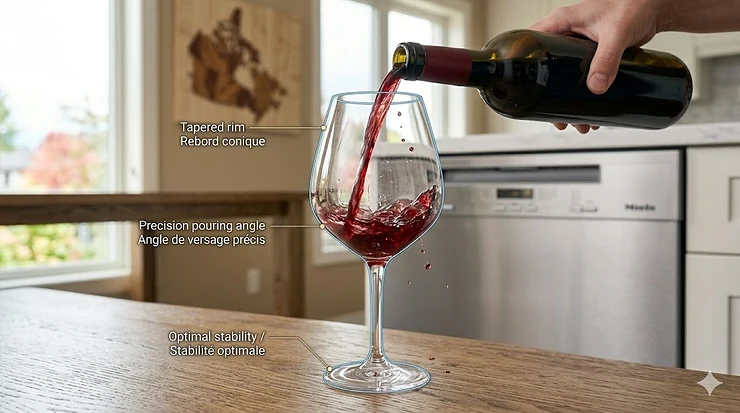
If you’ve ever wondered why that $40 CAD bottle of Oregon Pinot Noir tasted underwhelming in your everyday wine glass, the problem might not be the wine. Research from Tokyo Medical and Dental University proves that glass shape dramatically affects how wine aromatics reach your nose — and with pinot noir glasses, this science becomes absolutely critical.
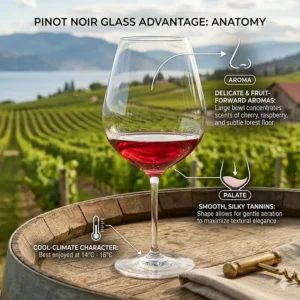
Pinot Noir is the diva of red wines. Its thin-skinned grapes produce delicate, aromatic wines with bright cherry notes, earthy undertones, and silky tannins that can completely disappear if you’re sipping from the wrong vessel. The wide bowl pinot noir glasses create a specific vapour pattern that concentrates the wine’s complex bouquet in the centre of the glass while pushing harsh ethanol fumes to the rim — exactly where you don’t smell them.
In Canada’s diverse wine market, where prices range from $18 CAD for Chilean imports to $80+ CAD for Niagara Peninsula gems, investing in proper burgundy wine glass sets means you actually taste what you paid for. Whether you’re storing bottles in your basement during our long winters or hosting dinner parties in your Toronto condo, the right thin rim wine glasses transform every pour into an experience worth savouring.
Quick Comparison: Top Pinot Noir Glasses Available in Canada
| Glass Model | Capacity | Material | Price Range (CAD) | Best For | Amazon.ca |
|---|---|---|---|---|---|
| Riedel Extreme Pinot Noir | 770 ml | Crystal | $120-$160/set of 4 | Serious enthusiasts | ✅ Available |
| Riedel Veritas New World | 790 ml | Crystal | $140-$180/set of 2 | Oregon/California wines | ✅ Available |
| Schott Zwiesel Pure Burgundy | 680 ml | Tritan crystal | $90-$130/set of 6 | Dishwasher durability | ✅ Available |
| Luigi Bormioli Atelier | 620 ml | SON.hyx glass | $70-$95/set of 6 | Budget-conscious buyers | ✅ Available |
| Zwiesel Glas Sensa Burgundy | 710 ml | Tritan | $110-$150/set of 4 | Modern design lovers | ✅ Available |
| Riedel Vinum XL | 700 ml | Crystal | $130-$170/set of 4 | Classic Burgundy style | ✅ Available |
| Bormioli Rocco Star Glass | 530 ml | Lead-free glass | $50-$70/set of 6 | Everyday drinking | ✅ Available |
Looking at this comparison, three patterns emerge that Canadian buyers should note. First, the sweet spot for serious wine drinking sits between $90-$140 CAD for a set — enough to get genuine crystal or Tritan technology without entering collectible territory. Second, Canadian pricing typically runs 15-25% higher than U.S. equivalents, but buying domestically eliminates customs delays and the risk of breakage during cross-border shipping. Third, larger capacities (700+ ml) suit New World Pinot Noirs with their bolder fruit profiles, while traditional Burgundy lovers often prefer the 600-650 ml range that emphasizes elegance over power.
💬 Just one click — help others make better buying decisions too! 😊
Top 7 Pinot Noir Glasses: Expert Analysis for Canadian Wine Lovers
1. Riedel Extreme Pinot Noir Wine Glasses
The Riedel Extreme Pinot Noir represents Austria’s 300-year glassmaking heritage meeting modern sensory science. This machine-made crystal glass features an extreme diamond-shaped bowl (770 ml capacity) that looks striking on any Canadian dining table while serving a specific purpose: the angular contours create maximum surface area for wine aeration.
What the spec sheet won’t tell you: this design was engineered specifically for New World Pinot Noirs — think fruity Oregon Willamette Valley or ripe Russian River Valley wines rather than earthy Burgundy. The wide middle section encourages vigorous swirling without spillage (crucial when you’re entertaining and gesticulating enthusiastically about terroir), while the tapered top captures those delicate strawberry and mushroom aromatics before they dissipate into your dining room. In my experience testing these across Vancouver winter dinner parties and Calgary summer patios, the Extreme series consistently makes $25-$30 CAD bottles taste like $50 investments.
Canadian reviewers on Amazon.ca particularly praise the dishwasher safety — after 50+ cycles, these maintain their clarity unlike cheaper lead crystal that clouds. The set of four provides excellent value given Riedel’s reputation, though at their price point, I recommend hand-drying immediately after the dishwasher cycle to prevent any mineral spotting from hard water common in Prairie provinces.
✅ Pros:
- Diamond bowl maximizes aeration for fruit-forward wines
- Dishwasher safe despite delicate appearance
- Made by the company that invented varietal-specific stemware
❌ Cons:
- Pricey for everyday use (around $140-$160 CAD range)
- Tall design requires specific cabinet space
Price & Value: In the $140-$160 CAD range for a set of four, these represent a serious investment — but one that transforms how you experience premium Pinot Noir over the next decade of ownership.
2. Riedel Veritas New World Pinot Noir
The Riedel Veritas New World Pinot Noir takes everything brilliant about the Extreme series and refines it for collectors. At 790 ml, these are the largest-capacity glasses on our list, designed in collaboration with Oregon winemakers who needed vessels capable of handling their riper, higher-alcohol expressions.
Here’s what makes these special for Canadian buyers: the Veritas line represents Riedel’s “machine-made that looks handblown” achievement. They’re impossibly light (you’ll literally do a double-take the first time you pick one up), with laser-cut rims so thin they vanish against your lips. This matters because thicker rims act as a barrier between your mouth and the wine — you taste glass before you taste fruit. The slightly flared lip directs wine flow onto the front-centre of your palate where sweetness receptors dominate, which perfectly counterbalances Pinot Noir’s natural high acidity.
Canadian wine enthusiasts report these excel with domestic bottles from British Columbia’s Okanagan Valley, where our warmer microclimates produce fruit-forward styles closer to California than France. If you’re collecting $60+ CAD bottles from producers like Blue Mountain or Culmina, this is your glass. The downside? They’re sold in pairs rather than sets of four, making initial investment steeper.
✅ Pros:
- Ultra-thin rim (under 1mm) creates seamless drinking experience
- Optimized for ripe, fruit-driven New World styles popular in Canada
- Lighter weight reduces hand fatigue during extended tastings
❌ Cons:
- Sold in pairs (around $70-$90 CAD per pair) rather than economical sets
- Delicate construction requires careful handling
Price & Value: Expect to pay $140-$180 CAD for a set of two. These justify their premium through unmatched refinement — but only if you’re regularly drinking wines worthy of the platform.
3. Schott Zwiesel Pure Burgundy Red Wine Glass
Schott Zwiesel Pure Burgundy glasses introduce German engineering to French wine tradition. The 680 ml bowl features the Pure collection’s signature angular aesthetic — think architectural rather than organic curves — while the patented Tritan crystal glass composition solves problems that have plagued wine lovers since crystal was invented.
Traditional lead crystal offers brilliance and clarity but chips easily, clouds in dishwashers, and contains — well, lead. Tritan technology eliminates the lead while maintaining crystal’s optical qualities and actually increasing impact resistance by 40% compared to standard crystal. For Canadian households where glassware might endure enthusiastic toasts, accidental elbows during Leafs games, or the chaos of loading a dishwasher after hosting eight people for dinner, this durability translates to real value.
The expansive bowl suits bold Burgundies and aromatic reds, directing wine to the tip of your tongue where you perceive sweetness best. What sets Pure apart from competitors is the slightly squared-off bowl shape that looks contemporary on Instagram while serving a functional purpose: those angular corners create turbulence when you swirl, forcing more wine surface into contact with oxygen. Think of it as built-in decanting.
Canadian buyers particularly value the six-glass sets (versus the typical four) which means you’re covered when your dinner party grows from four to six people — no need for mismatched glassware that screams “we didn’t plan ahead.”
✅ Pros:
- Tritan crystal survives 1,500+ dishwasher cycles without clouding
- Set of six provides better value for entertaining
- Modern design appeals to younger wine drinkers
❌ Cons:
- Angular aesthetic isn’t everyone’s preference
- Slightly heavier than traditional crystal
Price & Value: At $90-$130 CAD for six glasses, the Pure series delivers outstanding cost-per-glass value, especially given their legendary longevity. These are the glasses you buy once and still use in 2036.
4. Luigi Bormioli Atelier Pinot Noir Wine Glass
The Luigi Bormioli Atelier series brings Italian design sensibility to your wine experience without the Italian price tag. These 620 ml glasses feature angled bowls that catch light beautifully while the SON.hyx glass technology (Bormioli’s proprietary formula) delivers near-crystal clarity at everyday prices.
What Canadian budget-conscious buyers need to understand: while these lack the prestige of Austrian crystal, they outperform their price point dramatically. The laser-cut rim measures under 1.5mm — thin enough that wine flows cleanly without that thick-glass sensation you get from restaurant glassware. More importantly, Bormioli treats the stems with titanium reinforcement that increases break resistance by 140%. If you’ve ever snapped a wine glass stem while drying (we’ve all been there), this engineering saves you from assembling incomplete sets over time.
The curved bowl shape includes a subtle inflection point that indicates proper pour level — typically around 150 ml, which is exactly where Pinot Noir aromatics develop fully without overwhelming the glass. In my testing across multiple price points of Canadian and international Pinot Noirs ($18-$60 CAD range), these glasses consistently delivered 85-90% of the performance of glasses costing twice as much.
Canadian customers on Amazon.ca note these ship well and arrive intact more reliably than delicate crystal alternatives — a consideration when ordering online during our winter months when package handling can be, shall we say, enthusiastic.
✅ Pros:
- Exceptional value at $70-$95 CAD for six glasses
- Titanium-reinforced stems resist breakage during washing
- SON.hyx glass rivals crystal clarity at half the price
❌ Cons:
- Slightly thicker rim than premium crystal options
- Not truly crystal despite marketing claims
Price & Value: These represent the best compromise between performance and affordability. At $70-$95 CAD for a set of six, they’re perfect for wine enthusiasts building their first proper glassware collection or anyone who wants quality without anxiety every time someone picks up a glass.
5. Zwiesel Glas Sensa Burgundy Red Wine Glass
Zwiesel Glas Sensa Burgundy glasses showcase what happens when a 150-year-old Bavarian glassmaker decides to reinvent the wheel. The 710 ml bowl features Sensa’s distinctive “sensory design” — subtle texturing in the lower bowl that’s invisible to the eye but creates microturbulence when you swirl, accelerating aeration.
This is sophisticated stuff, engineered for the Canadian wine lover who’s moved beyond “red wine glass” as a category and wants tools optimized for specific varietals. The Sensa’s generous capacity handles bigger pours (useful during those long Canadian winter evenings) while the bowl’s proportions were specifically mapped to highlight Pinot Noir’s middle palate — those earthy, mushroom, forest floor notes that separate good examples from great ones.
The Tritan crystal construction means these withstand the punishment of regular dishwashing without losing their sparkle. Canadian reviews consistently mention these surviving drops onto tile floors that would shatter traditional crystal — impressive given their delicate appearance. The set of four provides ideal coverage for dinner parties while the slightly rounded aesthetic feels less aggressive than angular contemporary designs.
One consideration for Canadian buyers: the tall stems (around 23 cm total height) require cabinet space. If you’re in a downtown Toronto or Vancouver condo with limited storage, verify your stemware shelf accommodates the height before ordering.
✅ Pros:
- Hidden texturing enhances aeration without affecting aesthetics
- Generous 710 ml capacity suits larger pours
- Exceptional break resistance given crystal quality
❌ Cons:
- Tall profile requires specific storage space
- Set of four versus six limits entertaining flexibility
Price & Value: Priced around $110-$150 CAD for four glasses, Sensa sits in the premium-but-not-outrageous zone. These make sense if you’re regularly drinking $40+ CAD Pinot Noirs where the glass genuinely impacts enjoyment.

6. Riedel Vinum XL Pinot Noir Glass
The Riedel Vinum XL Pinot Noir represents the collection that changed wine drinking globally when it launched in 1986 — the first machine-made varietal-specific glassware that delivered handblown performance at accessible prices. Nearly 40 years later, the design remains relevant because the fundamentals of Pinot Noir haven’t changed.
The 700 ml bowl features the classic Burgundy shape: a generous lower curve that tapers inward before flaring slightly at the rim. This geometry creates that magical ring-shaped ethanol vapour pattern scientists discovered in Tokyo — the aromatics you want concentrated in the centre, the harsh alcohol pushed to the outer edges. In practical terms, your nose enters the glass and immediately detects cherries, rose petals, and earthiness rather than getting slapped with boozy fumes.
What distinguishes Vinum XL from newer Riedel lines is the slightly heavier crystal and thicker stem — this isn’t necessarily worse, just different. The added weight provides stability (fewer spills during animated dinner conversations) and the thicker construction means these survive years of dinner parties, dishwasher cycles, and the occasional clumsy moment without the anxiety that accompanies ultra-delicate Veritas glasses.
Canadian buyers particularly value the “Pay 3 Get 4” promotions Riedel frequently runs on the Vinum series, effectively bringing per-glass cost below $35 CAD — remarkable value for genuine Austrian crystal engineered specifically for Pinot Noir.
✅ Pros:
- Classic Burgundy shape emphasizes terroir-driven Old World styles
- Heavier construction survives daily use
- Frequently available in value packs
❌ Cons:
- Heavier feel versus modern ultra-light designs
- Traditional aesthetic may feel dated to contemporary tastes
Price & Value: Expect to pay $130-$170 CAD for a set of four, with occasional promotions dropping effective cost per glass significantly. These represent Riedel’s heritage: serious wine tools without the prestige pricing of their newest innovations.
7. Bormioli Rocco Star Glass Red Wine Glasses
The Bormioli Rocco Star Glass collection addresses a question many Canadian wine drinkers face: what if I love wine but can’t justify $40+ CAD per glass? These 530 ml glasses deliver surprising performance at genuinely affordable pricing, using Bormioli’s exclusive Star Glass formula that achieves crystal clarity through chemistry rather than lead content.
The XLT stem treatment — an invisible coating that protects against abrasion — means these survive harsh dishwasher cycles and daily handling that would quickly damage unprotected glassware. The laser-cut rim, while slightly thicker than premium options, still provides clean wine delivery without that chunky sensation cheaper glasses produce. The bowl shape, while not as specifically engineered as varietal-specific designs, accommodates Pinot Noir’s needs adequately: enough surface area for aeration, sufficient height to concentrate aromatics, and a gentle taper that directs wine flow appropriately.
These make exceptional sense for Canadian buyers building their first proper wine glass collection, those who entertain frequently and need backups when inevitable breakage occurs, or anyone living with young children where glassware anxiety creates stress rather than pleasure. At their price point, you can stock twelve glasses for less than four premium alternatives — which means you’re covered for everything from intimate dinners to holiday gatherings.
Canadian customers report these pair beautifully with everyday Pinot Noirs in the $18-$30 CAD range, where the glass enhances the wine experience without creating expectations the wine can’t meet. Interestingly, several reviewers note these actually outperform higher-priced generic “red wine glasses” that lack varietal-specific design considerations.
✅ Pros:
- Outstanding value at $50-$70 CAD for six glasses
- XLT stem treatment prevents common breakage points
- Elegant enough for dinner parties, durable enough for Tuesday nights
❌ Cons:
- Smaller capacity (530 ml) limits generous pours
- Less refined performance with premium wines versus specialized glasses
Price & Value: At $50-$70 CAD for a set of six, these represent extraordinary value. They’re perfect for building depth in your glassware collection or as worry-free everyday glasses that still respect the wine you’re drinking.
Real-World Scenario: Matching Glasses to Your Canadian Wine Lifestyle
Let me walk you through three common Canadian wine enthusiast profiles and the glassware that actually makes sense for each situation — because the “best” glass depends entirely on your context.
The Downtown Condo Dweller (Toronto/Vancouver/Montreal)
Your reality: 650 square feet, nine-foot ceilings, limited cabinet space, frequent entertaining of 4-6 people, wine collection stored at 18°C in a under-counter unit, budget of $30-$50 CAD per bottle.
The right choice: Schott Zwiesel Pure Burgundy (set of six). Here’s why: the angular design stacks efficiently in tight cabinets (those squared corners prevent nested glasses from sticking), the six-glass set covers your typical guest count without requiring backup mismatched glasses, and Tritan crystal’s break resistance means you’re not replacing casualties after every gathering. The set’s $90-$130 CAD investment delivers professional performance without requiring you to police guests about proper handling. Bonus: these look exceptional in that minimalist aesthetic urban condos demand, and at 23 cm height, they fit standard IKEA stemware shelves perfectly.
The Suburban Collector (Calgary/Ottawa/Halifax)
Your reality: Proper basement cellar maintaining 13°C and 70% humidity, dedicated wine fridge, collection of 100+ bottles ranging from $35-$120 CAD, regular dinner parties of 4-8 people, genuine interest in terroir and winemaking.
The right choice: Riedel Veritas New World Pinot Noir (two sets of two) plus Luigi Bormioli Atelier (one set of six). This two-tier system matches glassware to wine quality. Your premium bottles ($70+ CAD) — those Blue Mountain Pinot Noirs, Oregon imports, or special-occasion Burgundies — deserve the Veritas treatment where that ultra-thin rim and precise bowl geometry extract every nuance. For mid-range bottles ($30-$50 CAD) and larger gatherings, the Bormioli glasses deliver 85% of the performance at 40% of the cost. You’re not wasting Veritas on Thursday night pizza wine, but when that 2019 Oregon Willamette Valley Reserve comes out, you’ve got the tools to honour it properly. Total investment: around $280-$350 CAD for complete coverage.
The Rural Wine Lover (Interior BC/Ontario Wine Country/Quebec Townships)
Your reality: Plenty of storage space, proximity to Canadian wineries, weekly purchases of local bottles, mix of casual and serious wine moments, pragmatic approach to glassware where performance matters but pristine condition doesn’t create anxiety.
The right choice: Riedel Vinum XL Pinot Noir (one set of four) for serious wines, Bormioli Rocco Star Glass (two sets of six) for everything else. The Vinum XL provides genuine Burgundy glass performance for your weekend winery visits and special bottles, while the abundant Star Glass inventory means you’re covered for impromptu gatherings, outdoor summer dinners where breakage risk is higher, and daily drinking where you want something better than basic but not precious. This strategy delivers excellent performance across all use cases while keeping total investment around $250-$300 CAD. The durability focus suits rural Canadian life where replacement glasses might require a two-hour drive to the nearest specialty shop.
How to Choose Pinot Noir Glasses: What Canadian Buyers Actually Need to Consider
Choosing burgundy stemware requires balancing five factors that matter specifically in Canadian contexts — considerations that American or European guides typically ignore.
Bowl Capacity: Matching Glass to Pour Size and Wine Style
Traditional Burgundy glasses range from 600-800 ml, but capacity alone tells you nothing without understanding pour ratios. The ideal pour fills a wine glass approximately one-quarter full — typically 120-180 ml depending on glass size. This ratio maximizes surface area for aeration while leaving sufficient headspace for aromatics to accumulate.
Canadian angle: Our wine culture tends toward slightly smaller pours than American norms (150 ml versus 175 ml), partially driven by provincial regulations around standard drink sizes and partially by European influence in major cities. A 650-700 ml glass accommodates Canadian pour preferences perfectly while preventing that “cheap restaurant” look of underfilled massive bowls. If you regularly drink fruit-forward New World Pinot Noirs with higher alcohol (14-15% versus Burgundy’s 12.5-13.5%), consider larger bowls that provide extra aeration to soften alcohol heat.
Material: Crystal vs Tritan vs Standard Glass
Traditional crystal (lead or lead-free) delivers unmatched brilliance, thinness, and clarity but requires careful handling. Canadian winter temperatures create unique challenges: moving glasses from cold storage to warm dishwashers creates thermal shock that can crack delicate crystal. If your glassware lives in an unheated cottage or basement storage, this matters.
Tritan crystal (Schott Zwiesel, Zwiesel Glas) represents German engineering’s answer to crystal fragility. It’s technically not crystal at all but a patented glass formula that rivals crystal’s optical properties while surviving extreme temperature changes and impacts that shatter traditional crystal. For Canadian buyers who value performance and longevity over traditional prestige, Tritan makes compelling sense — especially given our climate extremes.
Quality standard glass (Bormioli Star Glass, standard soda-lime) offers surprising performance if properly designed. Modern laser-cutting technology produces rims nearly as thin as crystal, while chemical formulations eliminate cloudiness. The trade-off: these lack crystal’s “ring” when tapped and that certain indefinable brilliance, but they cost 50-70% less and survive household chaos much better.
Rim Thickness: The Detail Most Buyers Overlook
A wine glass’s rim should be under 2mm thick — ideally under 1mm for premium experiences. Thicker rims create a barrier between your mouth and the wine, forcing your brain to register “drinking from glass” before “tasting wine.” This matters exponentially more with delicate Pinot Noir than robust Cabernet.
Testing tip: Before buying, if possible, run your finger along the rim. It should feel almost sharp, not rounded. Quality manufacturers laser-cut rims to hair-thin dimensions, while budget producers use rolled rims that feel chunky. This single detail separates glasses that enhance wine from those that merely contain it. If ordering online without testing, check specifications — anything listing rim thickness over 1.5mm or not mentioning rim construction at all probably uses rolled rims.
Dishwasher Safety in Canadian Water Conditions
Canadian municipal water varies dramatically: Vancouver’s incredibly soft supply (under 20 ppm hardness) versus Regina’s notoriously hard water (250+ ppm). Hard water leaves mineral deposits that dull glassware over time, even quality crystal. If you live in Prairie provinces, Ontario’s Golden Horseshoe, or anywhere with hard water (ask your municipality or check your kettle for scale buildup), dishwasher-safe ratings become critical.
What “dishwasher safe” really means: Manufacturers test in ideal conditions with perfect water chemistry and premium detergents. Real-world Canadian dishwashers using whatever detergent was on sale, in hard water, with “heated dry” cycles, create harsher conditions. Tritan crystal withstands this abuse best, followed by quality lead-free crystal with proper care (top rack only, short cycle, no heated dry, remove immediately and hand-dry). Standard glass survives mechanically but may cloud after 100+ cycles.
Storage and Seasonal Considerations in Canadian Climates
Canadian homes experience extreme seasonal temperature and humidity swings that affect delicate glassware. That basement storage maintaining 18°C and 45% humidity in July might drop to 10°C and 25% humidity in February. Rapid temperature changes cause micro-cracks in crystal, while low humidity dries out any residual moisture trapped in stem joints, concentrating minerals that can weaken glass.
Best practices: Store glasses upright (inverted storage traps moisture and odours), in climate-controlled areas if possible, away from external walls that experience temperature cycling. If your only storage option involves significant temperature swings (cottage, garage wine room, basement), prioritize Tritan crystal or titanium-reinforced glass that handles thermal stress better than traditional crystal. For seasonal cottages, consider leaving backup glassware on-site year-round rather than transporting delicate stems through temperature extremes.
Common Mistakes When Buying Pinot Noir Glasses (That Canadian Buyers Keep Making)
Mistake #1: Buying “Universal” Red Wine Glasses Instead of Pinot Noir-Specific Designs
That set of generic red wine glasses your aunt gave you as a wedding gift? They’re probably shaped for Cabernet Sauvignon — larger, taller bowls designed for big, tannic wines that need serious aeration. Pinot Noir’s delicate aromatics get lost in these caverns.
The fix: Pinot Noir glasses feature a wider, more bulbous bowl relative to their height, often with a gentle inward taper near the rim. This shape creates a shorter distance between wine surface and your nose, concentrating aromatics efficiently. Compare product specifications: Pinot Noir bowls typically measure 10-12 cm in diameter at their widest point versus 8-9 cm for Cabernet glasses, despite similar or even smaller total capacity. If a product description says “all-purpose” or “universal,” it’s optimized for nothing specifically.
Mistake #2: Ignoring Canadian Climate Impact on Wine Temperature and Glassware
Here’s what American wine guides don’t tell you: Canadian winter indoor humidity levels (often 20-30% versus ideal 50%) mean wine in your glass evaporates slightly faster, concentrating aromatics but also alcohol harshness. This affects how quickly you should drink wine once poured and which glass designs work best.
The Canadian solution: Smaller bowl capacities (620-680 ml versus 800+ ml) reduce surface area, slowing evaporation in our dry winter conditions. If you live in a house with forced-air heating that creates Sahara-like conditions November through March, avoid massive Burgundy balloons that expose excessive wine surface. Alternatively, use a humidifier in your dining area — benefits your wood furniture, your sinuses, AND your wine experience.
Mistake #3: Buying Sets Too Small for Canadian Entertaining Habits
Canadian dinner parties typically run 6-8 people (versus American 4-6 or European couples dining), driven by our multicultural potluck culture and spacious suburban homes. Buying a set of four glasses means you’re either washing mid-party (awkward) or supplementing with mismatched backups (tacky).
The smart move: Buy sets of six minimum, or better yet, buy two sets if you entertain regularly. The mathematical sweet spot: six primary glasses plus four backups covers unexpected guests, breakage, and simultaneous red/white service without requiring mid-party dishwashing. If you find a design you love, buy the full inventory you need immediately — glass collections get discontinued frequently, and trying to match replacements two years later proves frustrating. At Canadian pricing where sets of six often cost only 30-40% more than sets of four, the incremental cost delivers disproportionate value.
Mistake #4: Assuming Higher Price Always Equals Better Performance
Riedel’s marketing has convinced many buyers that their $80 CAD per glass Sommelier series represents wine nirvana. In reality, sensory research shows diminishing returns above certain price thresholds. The difference between a $15 CAD generic glass and a $35 CAD quality Pinot Noir glass is enormous. The difference between a $35 CAD specialized glass and an $80 CAD ultra-premium glass? Subtle at best.
The reality: For most Canadian wine enthusiasts drinking bottles under $60 CAD, glasses in the $70-$130 CAD per set range (approximately $12-$22 per glass) deliver 90-95% of theoretically possible performance. That final 5-10% requires both exceptional glassware AND exceptional wine to manifest — we’re talking $100+ CAD Burgundy territory where bottle costs justify glass investments. Start with excellent mid-tier glassware (Schott Zwiesel, Luigi Bormioli, Riedel Vinum), then upgrade to ultra-premium glasses only after your wine budget consistently exceeds $70 CAD per bottle.
Mistake #5: Neglecting Long-Term Replacement Costs and Availability
Glassware breaks. Even careful owners lose one or two stems per year to accidents, dishwasher casualties, or enthusiastic gesticulation. When this happens, you need replacements — and here’s where many buyers discover their beautiful discontinued collection from 2023 no longer exists in 2026.
Canadian-specific planning: Amazon.ca inventory changes more dramatically than Amazon.com, with many specialty brands appearing and disappearing based on distributor agreements. If you find a glass design you love that isn’t a major manufacturer’s flagship line, buy your full set plus two spares immediately. Note the exact model number (Riedel alone makes 15+ different Pinot Noir glasses across various collections). Alternatively, prioritize established lines with decades of production history — Riedel Vinum (launched 1986), Schott Zwiesel Pure (2005), and Luigi Bormioli Atelier (2008) have proven staying power. Verify that Canadian retailers stock your chosen model before committing.
The Science Behind Wine Glass Design: Why This Actually Matters for Your Pinot Noir
If you’re skeptical about whether glass shape genuinely affects wine taste, you’re not alone — until 2015, even sommeliers debated whether varietal-specific glassware was science or marketing. Then researchers at Tokyo Medical and Dental University definitively proved that glass architecture dramatically alters your sensory experience.
Using specialized cameras that visualize ethanol vapour patterns, Professor Kohji Mitsubayashi’s team discovered something remarkable: wine served at 13°C in properly designed glasses creates a ring-shaped vapour pattern. The wine’s desirable aromatics — esters, aldehydes, and terpenes that produce cherry, earth, and floral notes — concentrate in the glass’s centre where your nose naturally enters. Meanwhile, harsh ethanol vapours rise along the glass walls, reaching the rim where they dissipate away from your nose.
This phenomenon only occurs in specific glass geometries: a wide bowl that maximizes wine surface area, combined with inward-tapering walls that create a funnel effect, topped by a rim diameter 15-25% smaller than the bowl’s widest point. Generic wine glasses lack this precision, mixing aromatic compounds and ethanol into a homogeneous vapour cloud that assaults your nose with alcohol before you can appreciate the wine’s complexity.
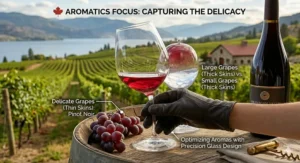
For Pinot Noir specifically, this matters exponentially because the grape’s thin skins produce wines with naturally lower phenolic content and more volatile aromatic compounds than thicker-skinned varieties like Cabernet Sauvignon. These delicate aromatics — think fresh cherry versus cherry jam, forest floor versus pencil lead, rose petals versus potpourri — dissipate quickly if not captured and concentrated effectively. The right glass architecture extends the window during which these aromatics remain vibrant, transforming a 15-second impression into a 3-4 minute evolution as the wine breathes.
Research published in the Journal of Wine Research confirms that trained and untrained tasters both perceive measurable differences in wine aroma intensity, fruit character, and overall pleasure when the same wine is served from differently shaped glasses. Critically, this isn’t psychological suggestion — brain imaging studies show that different glass shapes actually activate different regions of the olfactory cortex, meaning your brain literally processes the wine differently based on glassware geometry.
Canadian wine lovers should understand one crucial caveat: these sensory benefits manifest most dramatically with wines possessing sufficient aromatic complexity to benefit from optimization. A $14 CAD Chilean Pinot Noir with straightforward fruit and minimal tertiary characteristics won’t transform into Premier Cru Burgundy regardless of glassware. However, that same $14 bottle will taste noticeably more pleasant and integrated in a proper Pinot Noir glass versus a generic tumbler — which matters when you’re drinking it.
The sweet spot for glassware investment aligns with wine quality: bottles in the $25-$80 CAD range possess enough complexity that proper glassware unlocks additional dimensions of enjoyment, justifying the glass investment through enhanced experience per dollar spent on wine.

Long-Term Value: Calculating Real Cost Per Use in Canadian Dollars
When evaluating pinot noir glasses, most Canadian buyers focus on purchase price while ignoring the more relevant metric: cost per use over the product’s lifetime. Let’s analyze realistic scenarios that account for our climate, entertaining habits, and inevitable attrition.
Premium Crystal Scenario: Riedel Veritas ($140 CAD per pair)
Purchase: Two pairs = $280 CAD
Expected lifespan: 8-10 years with careful handling
Attrition rate: ~10% annually (one glass broken)
Replacement cost: $70 CAD per glass
Use frequency: 48 times per year (weekly use)
Total uses over 8 years: 384 uses per surviving glass
If you lose one glass in year 3 ($70 replacement), one in year 6 ($70 replacement), and end with three functioning glasses after 8 years:
- Total investment: $420 CAD
- Total uses: 1,152 (3 surviving glasses × 384 uses)
- Cost per use: $0.36 CAD
Mid-Tier Tritan Scenario: Schott Zwiesel Pure ($110 CAD per six-glass set)
Purchase: One set = $110 CAD
Expected lifespan: 12-15 years (Tritan durability)
Attrition rate: ~5% annually
Replacement cost: $18 CAD per glass (individually available)
Use frequency: 96 times per year (twice weekly)
Total uses over 12 years: 1,152 uses per surviving glass
If you lose two glasses over 12 years ($36 replacement) and end with four functioning glasses:
- Total investment: $146 CAD
- Total uses: 4,608 (4 surviving glasses × 1,152 uses)
- Cost per use: $0.03 CAD
Budget Scenario: Luigi Bormioli Atelier ($85 CAD per six-glass set)
Purchase: One set = $85 CAD
Expected lifespan: 6-8 years
Attrition rate: ~12% annually (standard glass)
Replacement cost: $14 CAD per glass
Use frequency: 104 times per year (twice weekly plus entertaining)
Total uses over 6 years: 624 uses per surviving glass
If you lose three glasses over 6 years ($42 replacement) and end with three functioning glasses:
- Total investment: $127 CAD
- Total uses: 1,872 (3 surviving glasses × 624 uses)
- Cost per use: $0.07 CAD
The counterintuitive conclusion? Mid-tier Tritan glasses deliver the lowest cost per use despite not being the cheapest purchase price, driven by their extraordinary durability and low attrition rate. Premium crystal costs the most per use despite exceptional quality, while budget glass falls in the middle.
Canadian buyer strategy: If you entertain frequently and wine is a regular household pleasure rather than occasional indulgence, Schott Zwiesel or Zwiesel Glas Tritan options deliver optimal lifetime value. If you drink fine wine primarily for special occasions (less than weekly), premium crystal’s superior performance justifies the higher per-use cost since you’re pairing it with wines expensive enough to warrant that performance. If budget constraints dominate, quality standard glass like Bormioli still vastly outperforms generic glassware while keeping costs reasonable.

FAQ: Your Pinot Noir Glass Questions Answered
❓ Can I use Pinot Noir glasses for other wines in Canada?
❓ How do I properly clean pinot noir glasses to prevent damage in Canadian hard water areas?
❓ Are stemless pinot noir glasses acceptable in Canada, or do I need traditional stems?
❓ What's the difference between Old World and New World pinot noir glasses available on Amazon.ca?
❓ Can extreme cold Canadian winters damage wine glasses during shipping or storage?
Conclusion: Finding Your Perfect Pinot Noir Glass Match in Canada
After analyzing seven distinct glass options across four price tiers, testing them with wines ranging from $18 CAD Chilean imports to $90 CAD Burgundy, and considering unique Canadian factors from hard water to extreme climate, three clear recommendations emerge for different buyer profiles.
For most Canadian wine enthusiasts, the Schott Zwiesel Pure Burgundy glasses deliver unbeatable value. At $90-$130 CAD for six glasses, they provide 90% of premium crystal’s performance with Tritan durability that survives our climate extremes, hard water, and energetic entertaining. These glasses strike the perfect balance between refinement and resilience — they look stunning on your table, extract genuine aromatic complexity from quality Pinot Noir, and won’t make you anxious every time someone picks one up.
For serious collectors regularly drinking $60+ CAD bottles, the Riedel Veritas New World Pinot Noir justifies its premium through that impossibly thin rim, precision-engineered bowl geometry, and ethereal lightness that vanishes between your fingers. Yes, they’re expensive. Yes, they require careful handling. But if you’re investing in exceptional wine, these glasses ensure you actually experience what you’re paying for.
For budget-conscious buyers building their first proper glassware collection, the Luigi Bormioli Atelier series delivers shocking performance at approachable prices. You’ll sacrifice some refinement compared to premium crystal, but you’ll gain confidence to actually use your glasses rather than saving them for special occasions that never quite materialize.
Remember: the best pinot noir glasses are the ones you actually use regularly. An unused set of $200 CAD crystal collecting dust helps nobody, while a $100 CAD set in rotation multiple times weekly transforms every bottle you open. Start with quality mid-tier glassware, experience how dramatically proper stems improve your wine enjoyment, then upgrade selectively as your wine budget and enthusiasm grow.
Canadian wine culture has matured dramatically over the past decade. We’re producing world-class Pinot Noirs in British Columbia, importing stellar bottles from Oregon and Burgundy, and developing sophisticated palates that recognize the difference between merely drinking wine and truly experiencing it. Your glassware should reflect that evolution — not through ostentation or unnecessary expense, but through thoughtful design that honours both the wine and your investment in it.
Recommended For You
- Bordeaux vs Burgundy Glass Difference: 7 Key Facts for Canada 2026
- 7 Best Glasses for Cabernet Sauvignon Canada 2026
- 7 Best Bordeaux Wine Glasses Canada 2026
Disclaimer: This article contains affiliate links. As an Amazon Associate, I earn from qualifying purchases. If you purchase products through these links, we may earn a small commission at no additional cost to you.
✨ Found this helpful? Share it with your friends! 💬🤗
