In This Article
Glass wine glasses are stemmed or stemless drinking vessels made from soda-lime glass, crystal or lead-free crystal. They are shaped to funnel aroma toward your nose, show off a wine’s colour and clarity, and keep your hand’s warmth away from the pour. In Canada they range from sturdy dozen-packs to feather-light, mouth-blown showpieces.
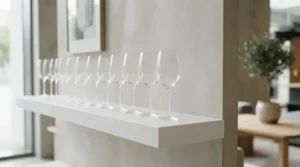
Here’s what most people discover late. The same C$20 bottle can taste flat in a thick, narrow tumbler and surprisingly lively in a thin-rimmed, properly sized bowl. It isn’t magic, just geometry. A wider bowl exposes more wine to air, and a tapered rim corralls aromas. A fine rim lets the liquid reach your palate without a lip-thick barrier in the way. The classic anatomy of bowl, stem and foot hasn’t changed much in centuries, but the materials, manufacturing methods and price tiers certainly have.
This guide is built for Canadian shoppers browsing amazon.ca in 2026. It compares seven real, widely sold options across budget, mid-range and premium tiers, using manufacturer specifications and aggregated reviewer commentary. You’ll find top rated glass wine glasses, wine glass shapes explained in plain language, and a look at how wine glass bowl size changes your pour. We also cover why glass clarity matters beyond looks, a glass stemware buying guide, and a tour of glassware brands. Then come Canadian lead-safety rules, care routines that prevent the dreaded stem snap, and which set suits which household.
A quick note on method: capacities vary slightly between listings, so confirm details on the product page before you buy.
Quick Comparison: Seven Glass Wine Glasses at a Glance
| Product | Type | Approx. Capacity | Price Range (CAD) | Best For |
|---|---|---|---|---|
| Gabriel-Glas StandArt | Stemmed, universal | 510–530 ml | C$75–C$110 per pair | One glass for every bottle |
| Riedel Vinum Cabernet Sauvignon/Merlot | Stemmed, red-specific | 610 ml | C$50–C$80 per pair | Bold reds on a sensible budget |
| Zalto Denk’Art Universal | Stemmed, mouth-blown | 530–555 ml | C$100–C$150 per glass | Serious enthusiasts |
| Zwiesel Glas Pure Cabernet | Stemmed, Tritan | 510–550 ml | C$150–C$220 per six | Durable, dishwasher-heavy homes |
| Riedel O Wine Tumbler Cabernet/Merlot | Stemless | 600 ml | C$40–C$60 per pair | Casual dinners, small cupboards |
| Libbey Vina Tall Wine Glass (12 oz) | Stemmed, regular glass | ~355 ml | C$60–C$100 per dozen | Parties and big households |
| Spiegelau Style Red Wine | Stemmed, lead-free crystal | ~630 ml | C$60–C$100 per four | Crystal feel for less |
The table shows how wide the spread is. Libbey Vina Tall Wine Glass (12 oz) costs only a few dollars per glass, while Zalto Denk’Art Universal can cost twenty times as much. Between them, Spiegelau Style Red Wine and Riedel O Wine Tumbler Cabernet/Merlot offer the best entry into thin, aromatic crystal-style bowls. Prices are approximate ranges at the time of research and may vary, so check current pricing on amazon.ca.
💬 Just one click — help others make better buying decisions too!😊
Top 7 Glass Wine Glasses: Expert Analysis
1. Gabriel-Glas StandArt — one shape for every bottle
The pitch here is radical simplicity: one universal bowl instead of a cupboard of varietal shapes.
The maker lists the glass at roughly 145 g, with a 95 mm base and a 66 mm opening. That wide base spreads even a small pour across a broad surface, while the narrower opening keeps aromas from escaping. It’s machine-blown, lead-free crystal in a single seamless piece, with no joins where stress could build. Retail listings cite 510–530 ml capacity, and one listing says it was tested over 1,000 dishwasher cycles. The maker also advises avoiding chlorinated tabs.
Based on the spec comparison, this suits people who drink across red, white and sparkling and would rather buy one good set than three mediocre ones. Reviewers consistently praise the elegant feel and aroma delivery. A few note fragility if handled roughly, one found the rounded rim a bit tactile, and another wanted a slightly bigger bowl. Listings also mention that Wirecutter named it a top classic universal glass in 2024.
Pros:
- ✅ Truly universal bowl suits reds, whites and bubbles
- ✅ Light, seamless, lead-free crystal construction
- ✅ Dishwasher safe with gentle detergent
Cons:
- ❌ Thin build still chips with rough handling
- ❌ Bowl runs modest for big-red lovers
Price range: roughly C$75–C$110 per pair. For versatility, that’s strong value.

2. Riedel Vinum Cabernet Sauvignon/Merlot — the big-bowl benchmark for reds
Vinum is Riedel’s accessible, machine-made take on its handmade Sommeliers range, first designed in 1986.
This glass holds 610 ml and stands 22.5 cm tall. In practice, that large bowl gives full-bodied reds room to open up, and a standard 142 mL (5 oz) pour fills barely a quarter of it. The maker says the shape softens perceived tannin and emphasizes fruit. That’s a marketing claim, though a big bowl does give tannic wines more air contact. It’s dishwasher safe, but check clearance, because Riedel itself notes some tall glasses won’t fit top racks.
Here’s what to weigh: this is a red-wine specialist. If your fridge holds Pinot Gris more often than Cabernet, look elsewhere. Reviewers praise the size and consistent quality, with one cautioning to inspect the stem for smoothness on arrival. Listings describe the material as crystal, but composition details vary by seller, so confirm lead-free status on the product page if that matters to you.
Pros:
- ✅ Generous bowl for full-bodied reds
- ✅ Machine-made consistency at accessible pricing
- ✅ Dishwasher safe for daily use
Cons:
- ❌ Tall profile may not fit shallow dishwasher racks
- ❌ Too specialized for white-wine households
Price range: around C$50–C$80 per pair. Good value for committed red drinkers.
3. Zalto Denk’Art Universal — featherweight hand-blown showpiece
Zalto’s reputation rests on near-impossible thinness paired with surprising springiness.
At roughly 130 g, 235 mm tall and 530–555 ml, it’s lighter than most glasses carrying half its capacity. The bowl is tilted at angles of 24, 48 and 72 degrees, inspired by the Earth’s axial tilt per the maker, and designed with Austrian “wine priest” Hans Denk. Practically, the thin rim makes wine feel like it arrives directly on your palate, and the maker calls it lead-free and dishwasher safe. Care matters, though: the maker says hand-washing adds torque that can snap bowls, so load carefully and avoid phosphate-free detergents.
This is for the person who’ll genuinely notice the difference and will handle stems like they’re holding a baby bird. Trade commentary, including a well-known Financial Times wine column, praises its delicacy and “springy” feel rather than fragility. Verify the country of manufacture on the product page.
Pros:
- ✅ Exceptionally light with a razor-fine rim
- ✅ Universal shape flatters whites and lighter reds
- ✅ Lead-free and cloud-resistant per maker
Cons:
- ❌ Premium price per glass hurts when one breaks
- ❌ Requires careful loading and handling
Price range: roughly C$100–C$150 per glass. Worth it only if you’ll feel the difference.
4. Zwiesel Glas Pure Cabernet — Tritan toughness with angular style
When durability is non-negotiable, Tritan technology is the answer.
Zwiesel replaces lead with titanium and zirconium, producing a clear, lead-free glass the maker calls break-, chip- and scratch-resistant. The glass stands about 24 cm tall with a 10 cm top diameter, and retail specs list 510–550 ml. Laser-finished rims and a machine-made build keep prices sensible. For households that run glasses through the dishwasher daily, this toughness is the whole point.
The one debate is terminology: one reviewer argued Tritan isn’t “true crystal” because lead defines the term traditionally. That’s technically a naming dispute, not a performance flaw. Reviewers otherwise appreciate easy cleaning and sturdy feel. If you host often, the angular stem and sturdy construction suit noisy dinner parties.
Pros:
- ✅ Chip- and scratch-resistant Tritan construction
- ✅ Lead-free with strong clarity
- ✅ Dishwasher safe, built to last
Cons:
- ❌ Angular styling isn’t everyone’s taste
- ❌ Heavier feel than hand-blown rivals
Price range: around C$150–C$220 for six. Strong value for busy homes.
5. Riedel O Wine Tumbler Cabernet/Merlot — stemless with a varietal bowl
This was among the first stemless glasses to carry a genuinely varietal-specific bowl, introduced in the early 2000s.
It holds 600 ml and stands only 121 mm tall, so it slides into any dishwasher and sits low in cupboards. The bowl shape follows Riedel’s Vinum benchmark, per the maker. Riedel says most of its dishwasher-safe glasses survive about 1,000 wash cycles, but that’s a manufacturer claim. I couldn’t verify a robust consumer-review set for this exact listing, so treat sentiment as unconfirmed.
Stemless glasses trade temperature control for stability. Your palm warms the bowl, and you’ll leave fingerprints on the glass, so they suit reds served cool-ish at room temperature better than chilled whites. They’re ideal for apartments, patios and clumsy hosts.
Pros:
- ✅ No stem to snap in the dishwasher
- ✅ Varietal-style bowl in a casual format
- ✅ Compact for small cupboards
Cons:
- ❌ Hand warms the wine over time
- ❌ Smudges show easily on clear crystal
Price range: roughly C$40–C$60 per pair. Fair value for casual use.
6. Libbey Vina Tall Wine Glass (12 oz) — chip-guarded workhorse for crowds
Libbey built the Vina line for restaurants, which tells you what it’s engineered to survive.
This 12 oz (about 355 ml) glass stands roughly 20.6 cm tall and carries a Safedge rim-and-foot guarantee against chipping. It’s regular glass rather than crystal, so expect a thicker rim and less sparkle. But it holds a 142 mL (5 oz) pour comfortably with swirl room, and the dishwasher-safe, case-of-12 format suits entertaining. I couldn’t find a verified consumer review set, so I’m not summarizing sentiment.
If you host often, this removes anxiety. Breaking one costs a few dollars, not a night’s budget. It’s less aromatic than thin crystal, but for casual wine, spritzers and large gatherings, the trade-off makes sense.
Pros:
- ✅ Chip-resistant rim and foot design
- ✅ Dozens-friendly pricing for entertaining
- ✅ Dishwasher safe and stackable-friendly
Cons:
- ❌ Thicker rim mutes finer aromas
- ❌ Smaller bowl limits big-red expression
Price range: around C$60–C$100 per dozen. Excellent budget value.
7. Spiegelau Style Red Wine — crystal looks on a value budget
Spiegelau sits in that sweet spot where thin lead-free crystal meets machine-made pricing.
The glass holds about 630 ml (listings show 21.25–22.2 oz) and is made in Germany from lead-free crystal. The maker says its platinum glass process survived 1,500 dishwasher cycles in testing, though that’s a manufacturer claim. The large bowl works for Cabernet blends, and listing reviewers note it also works well for whites.
Reviewers praise the thin, easy-to-hold design and generous volume. They also warn that the glass is thin and the bowl delicate, so careful handling matters. For anyone moving up from thick tumblers, this is an affordable first step into proper stemware.
Pros:
- ✅ Lead-free crystal at accessible pricing
- ✅ Generous bowl with elegant stem
- ✅ Dishwasher safe per maker testing
Cons:
- ❌ Thin walls break if mishandled
- ❌ Large bowl overwhelms light white wines
Price range: roughly C$60–C$100 per four. A smart mid-range pick.
Spec Comparison: How the Seven Differ
| Product | Material | Construction | Dishwasher Safe? | Best For |
|---|---|---|---|---|
| Gabriel-Glas StandArt | Lead-free crystal | Machine-blown, seamless | Yes (maker) | Everyday universal use |
| Riedel Vinum Cabernet Sauvignon/Merlot | Crystal | Machine-made | Yes (maker) | Red-wine drinkers |
| Zalto Denk’Art Universal | Lead-free crystal | Mouth-blown | Yes (maker, careful) | Enthusiasts |
| Zwiesel Glas Pure Cabernet | Tritan lead-free crystal | Machine-made | Yes (maker) | Durability seekers |
| Riedel O Wine Tumbler Cabernet/Merlot | Crystal | Machine-made, stemless | Yes (maker) | Casual homes |
| Libbey Vina Tall Wine Glass (12 oz) | Regular glass | Machine-made | Yes | Large gatherings |
| Spiegelau Style Red Wine | Lead-free crystal | Machine-made | Yes (maker) | Value crystal |
Every glass here is dishwasher-rated, so convenience isn’t the dividing line; build quality and handling are. Zalto Denk’Art Universal buys feel at the cost of vigilance, while Zwiesel Glas Pure Cabernet buys toughness at the cost of delicacy. If you want a balance of both, Gabriel-Glas StandArt and Spiegelau Style Red Wine sit closest to the middle.
Care and Setup: A 30-Day Guide to Keeping Glass Wine Glasses Sparkling
New thin glasses fail in predictable ways, and almost all of them are avoidable.
Week 1: Load carefully. Space glasses so they don’t touch, and secure stems so they can’t swing. Zalto advises minimal detergent, and Gabriel-Glas advises avoiding chlorinated tabs. When in doubt, use a mild powder.
Week 2: Polish properly. Riedel recommends two cloths: one cupped around the bowl, one holding the foot. Never twist the bowl while gripping the base, because that torque is what snaps stems. Using soft water or a white-vinegar rinse removes mineral spots.
Week 3: Store smart. Keep glasses upright, bowl-up, with space between them. Riedel advises against storing glasses in the fridge, as flavours can transfer. If you’re short on space, Riedel O Wine Tumbler Cabernet/Merlot stacks safely far better than stemmed options.
Week 4: Diagnose cloudiness. Hazy glasses usually mean hard water or detergent residue rather than damage. Soak in diluted white vinegar, rinse thoroughly, and air-dry.
Common first-month mistakes: overfilling (a third of the bowl is plenty), washing while hot, and stacking wet glasses. Cheap sets like Libbey Vina Tall Wine Glass (12 oz) forgive more mistakes; Zalto Denk’Art Universal forgives almost none.
Real-World Scenarios: Matching Glass Wine Glasses to Your Household
Scenario 1: The apartment couple. Two people, a small dishwasher and cupboards the size of a shoebox. They drink mostly red, three nights a week. Riedel O Wine Tumbler Cabernet/Merlot (around C$40–C$60 per pair) fits every rack, survives clumsy elbows, and gives a proper bowl without a stem to snap. A set of two or four covers daily use.
Scenario 2: The weekend host. Ten guests, mixed reds and whites, and someone always knocks a glass over. Libbey Vina Tall Wine Glass (12 oz) by the dozen keeps replacement costs trivial. If budget allows, add a few Spiegelau Style Red Wine glasses for the people who care about aromatics. The total stays under about C$200.
Scenario 3: The curious enthusiast. Drinks across varietals, enjoys tasting notes, and wants one set that flatters everything. Gabriel-Glas StandArt delivers the universal approach for around C$75–C$110 per pair, with serious aromatic performance. If they graduate to cellar-worthy bottles, Zalto Denk’Art Universal becomes the upgrade.
Scenario 4: The busy family. Dishwasher runs daily, kids wander through, and fragile is a four-letter word. Zwiesel Glas Pure Cabernet (roughly C$150–C$220 per six) uses Tritan to resist chips and scratches, so everyday use doesn’t feel like walking on eggshells.
Top Rated Glass Wine Glasses: What the 2026 Roundups Agree On
Browse 2026’s top rated glass wine glasses lists, and a pattern emerges. One roundup names the Gabriel-Glas StandArt for best overall value, Zalto Denk’Art Universal as the luxury pick, and Riedel Vinum for aroma. Another highlights Riedel’s O tumbler as a top stemless choice. Reviewers repeatedly favour thin crystal with a slightly tapered bowl because it concentrates aroma, and that logic runs through the entire market.
Notice what the lists don’t say: they rarely crown a single winner for everyone. “Best” depends on how seriously you drink, how careful you are, and what you’ll spend. A top rated glass is only top rated for the person it fits. A hand-blown stem that survives 1,000 dishwasher cycles in a lab still has to survive your Friday-night load-in.
When you scan top rated glass wine glasses, check three things. Does the roundup list actual specifications such as capacity and weight? Does it acknowledge downsides, such as fragility? And does it explain who the glass is for? If the answer to all three is no, you’re reading a catalogue, not a review.
Wine Glass Shapes Explained: Bordeaux, Burgundy, Universal and Beyond
Wine glass shapes explained simply: the bowl’s width, height and rim diameter decide how much air touches the wine and how aromas funnel to your nose.
Bordeaux/Cabernet shapes (like Riedel Vinum Cabernet Sauvignon/Merlot) are tall with wide bowls. They suit structured, tannic reds because the larger surface area lets them open up.
Burgundy shapes are broader and rounder, built to collect delicate aromas from Pinot Noir and similar styles. If you love Pinot, a Burgundy glass beats a Bordeaux one.
White-wine shapes are narrower, which helps preserve cooler temperatures and concentrates delicate aromas. Retail guides note white glasses usually hold less than reds.
Universal shapes (like Gabriel-Glas StandArt and Zalto Denk’Art Universal) compromise by using a medium bowl with a gently tapered rim. They handle almost everything reasonably well, which is why so many buyers choose them.
Sparkling shapes are tulip or flute styles that preserve bubbles. Some specialists prefer a tulip, which has more room for aroma than a classic flute.
The practical rule: if you drink one style 80% of the time, buy a specific shape. If your drinking is varied, choose a good universal.
Wine Glass Bowl Size: How Big Is Too Big?
Wine glass bowl size confuses people because bigger looks fancier. It isn’t automatically better.
A standard drink of wine in Canada is commonly cited as 142 mL (5 oz). Fill only about a third of the bowl, and a 600 ml glass like Riedel O Wine Tumbler Cabernet/Merlot holds a pour with space left to swirl. A 355 ml glass like Libbey Vina Tall Wine Glass (12 oz) is fine too, just with less headspace.
Red-wine glasses typically hold 12 to 16 oz or more, giving ample swirl room. White glasses generally hold less, around 8 to 12 oz. That’s why Spiegelau Style Red Wine at roughly 630 ml suits Bordeaux blends but can swamp a delicate Riesling.
What most buyers overlook: bowl size interacts with pour size. A huge bowl with a tiny pour means little wine meets lots of air, so aromas dissipate. A small bowl with a generous pour limits swirling. Match the glass to how you actually pour, not to a restaurant ideal.
Rule of thumb: if you drink bold reds, go 550–650 ml. For everything else, 450–550 ml is plenty. Beyond that, you’re buying volume, not performance.
Glass Stemware Buying Guide: Stemmed vs Stemless
This glass stemware buying guide section tackles the question that splits households: stem or no stem?
Stemware exists so you can hold the glass without warming the drink, and the stem also lifts the bowl for swirling. Those are real functional benefits, especially for chilled whites and sparkling wine. Stemless glasses sacrifice temperature control for stability and storage ease.
| Feature | Stemmed | Stemless | Best For |
|---|---|---|---|
| Temperature control | Hand stays off the bowl | Palm warms the wine | Stemmed: whites and bubbles |
| Breakage risk | Stem snaps easily | Very low | Stemless: busy homes |
| Storage | Awkward | Compact | Riedel O Wine Tumbler Cabernet/Merlot |
| Elegance | Classic | Casual | Gabriel-Glas StandArt |
The table makes the trade-off clear. Choose stemmed glasses like Gabriel-Glas StandArt when presentation and temperature matter, and stemless like Riedel O Wine Tumbler Cabernet/Merlot when durability and storage rule. Many households do best with a small stemmed set for guests plus a stemless set for everyday use.

Glass Clarity: Crystal, Lead-Free Crystal and Regular Glass
Glass clarity matters because you’re judging colour, viscosity and sediment through the bowl. Cloudy or tinted glass hides all three.
Regular soda-lime glass is clear but thicker. Lead crystal traditionally offered extra brilliance and a finer cut rim, but it carries a health consideration. Health Canada’s guidance on lead crystalware explains that lead can transfer into acidic drinks such as wine, with higher risk the longer a drink is stored. That’s why decanters and long-term storage deserve more caution than a glass poured at dinner.
Modern lead-free alternatives close the clarity gap. Zwiesel Glas Pure Cabernet uses titanium and zirconium, and Gabriel-Glas StandArt, Spiegelau Style Red Wine and Zalto Denk’Art Universal are all marketed as lead-free. Clarity isn’t about price alone. A thin, well-polished lead-free glass can outshine a thick leaded one.
Quick clarity tests: hold the glass against a white sheet and check for tint, bubbles or haze. After washing, haze that wipes away is residue, not damage. Permanent cloudiness usually means etching from harsh detergent or very hard water.
Glassware Brands: Who Makes What and Why It Matters
Glassware brands differ less in snobbery than in manufacturing philosophy.
Riedel pioneered varietal-specific shapes and offers both handmade lines and machine-made, dishwasher-safe ranges like Riedel Vinum Cabernet Sauvignon/Merlot and Riedel O Wine Tumbler Cabernet/Merlot. Retail analyses of 2026 product coverage put Riedel at the top of brand mentions, followed by Zwiesel Glas and Zalto.
Zwiesel/Schott Zwiesel built Tritan, trading traditional lead for titanium durability in Zwiesel Glas Pure Cabernet. Its core pitch is toughness without sacrificing clarity.
Zalto stakes its reputation on ultra-thin, mouth-blown Denk’Art glasses like Zalto Denk’Art Universal. Expect delicacy and a premium.
Gabriel-Glas, created by Swiss/German wine critic René Gabriel, argues varietal-specific glasses are unnecessary and sells Gabriel-Glas StandArt as the “one for all” answer.
Spiegelau focuses on affordable, lead-free machine-made crystal, as in Spiegelau Style Red Wine. Libbey serves restaurants first and consumers second, which explains the chip-resistant design of Libbey Vina Tall Wine Glass (12 oz).
The takeaway: pick glassware brands by manufacturing priority. Want delicacy? Zalto. Toughness? Zwiesel. Simplicity? Gabriel-Glas. Value? Spiegelau or Libbey.
How to Choose Glass Wine Glasses: 6 Steps
- Identify what you drink most. If 80% is bold red, buy a red-specific glass; if it’s mixed, buy a universal.
- Set a per-glass budget. Knowing whether you’re spending C$5 or C$100 per glass narrows the field instantly.
- Check capacity against your pour. Aim for a bowl at least three times your usual pour volume.
- Match build to handling habits. Clumsy? Choose Tritan, stemless or Safedge-style rims.
- Verify material claims. Confirm lead-free status and dishwasher safety on the listing.
- Consider storage. Measure shelf height before buying tall stems.
Common mistakes: buying a full cabinet of varietal glasses you’ll rarely use, ignoring dishwasher clearance, and assuming “crystal” means lead-free. Neither assumption holds across every listing, so read the details.
Long-Term Cost: What Glass Wine Glasses Really Cost per Year
Sticker price misleads. The real cost includes breakage and replacement.
| Product | Approx. Cost per Glass | Replacement Pain | Best For |
|---|---|---|---|
| Libbey Vina Tall Wine Glass (12 oz) | C$5–C$8 | Minimal | Large gatherings |
| Spiegelau Style Red Wine | C$15–C$25 | Low | Value crystal |
| Riedel O Wine Tumbler Cabernet/Merlot | C$20–C$30 | Low | Casual homes |
| Zwiesel Glas Pure Cabernet | C$25–C$37 | Low (durable) | Frequent dishwashing |
| Riedel Vinum Cabernet Sauvignon/Merlot | C$25–C$40 | Moderate | Red drinkers |
| Gabriel-Glas StandArt | C$38–C$55 | Moderate | Versatility |
| Zalto Denk’Art Universal | C$100–C$150 | High | Enthusiasts |
Here’s the maths: if you break two glasses a year, that costs you roughly C$10–C$16 with Libbey Vina Tall Wine Glass (12 oz) but C$200–C$300 with Zalto Denk’Art Universal. A durable option like Zwiesel Glas Pure Cabernet lowers breakage risk, which can make it cheaper over years than a fragile cheaper set. Choose according to how you really handle glassware.
Safety and Regulations for Glass Wine Glasses in Canada
Canadian rules focus on what coatings and decorations can release. Under the federal Glazed Ceramics and Glassware Regulations, any drinking vessel with a distinctive exterior decorative pattern within 20 mm of the rim must not release lead above 4 mg/L or cadmium above 0.4 mg/L when tested. Products must also carry warnings such as “CONTAINS LEAD” where applicable.
For plain, undecorated wine glasses, the main practical concern is lead crystal. Health Canada suggests using lead-free tableware and storing drinks in lead-free containers. If you own vintage leaded crystal, use it for short-term service rather than storage, and avoid it for children.
When shopping on amazon.ca, scan the listing for lead-free wording, decorative rims and country of manufacture. Painted or enamelled rims deserve extra scrutiny.
Frequently Asked Questions
❓ Are glass wine glasses better than crystal?
❓ Can glass wine glasses go in the dishwasher?
❓ How many glass wine glasses do I need for a dinner party?
❓ Do stemless glass wine glasses affect taste?
❓ Where can I buy glass wine glasses in Canada?
Conclusion
The best glass wine glasses aren’t the most expensive; they’re the ones that match how you pour, wash and entertain. If you want a single set that handles everything, Gabriel-Glas StandArt is the safest universal bet. For bold reds, Riedel Vinum Cabernet Sauvignon/Merlot gives you a large bowl without a premium price. If durability is your priority, Zwiesel Glas Pure Cabernet survives daily dishwashing, while Riedel O Wine Tumbler Cabernet/Merlot wins on storage and breakage resistance.
Hosts on a budget should look at Libbey Vina Tall Wine Glass (12 oz), and anyone stepping up from thick tumblers will find Spiegelau Style Red Wine a gentle introduction to crystal. Collectors who will notice every gram of difference may find Zalto Denk’Art Universal worth the splurge. Whatever you choose, remember the basics: lead-free if possible, a bowl sized to your pour, and care routines that protect your investment.
✨ Your Next Great Glass Is a Click Away!
🍷 Compare current pricing and availability on amazon.ca, pick the glass that matches your habits, and give your next bottle the bowl it deserves. Cheers to better pours!
Recommended for You
- Glass Wine Glasses Set Of 4: 7 Best Picks For Canada (2026)
- Crystal vs Glass Wine Glasses: 7 Smart Picks Worth It In 2026
- Crystal Wine Glasses For Red Wine: 7 Best Picks (2026)
Disclaimer: This article contains affiliate links. As an Amazon Associate, I earn from qualifying purchases. If you purchase products through these links, we may earn a small commission at no additional cost to you.
✨ Found this helpful? Share it with your friends! 💬🤗
