In This Article
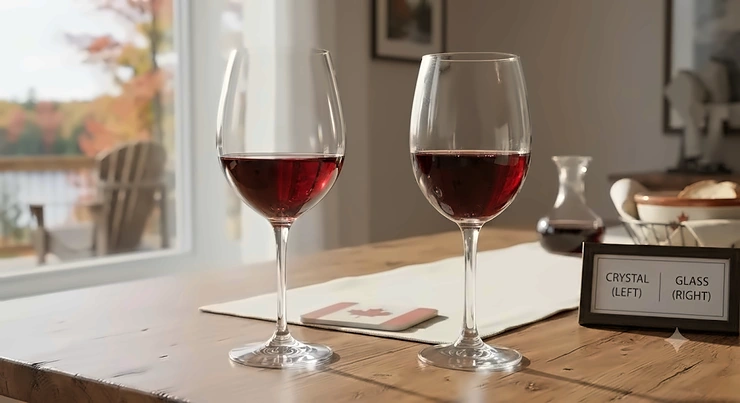
Pour the same Okanagan Pinot Noir into two glasses. One is a chunky restaurant-supply goblet; the other is a whisper-thin bowl that seems to float in your fingers. Same wine, same temperature, same bottle. Yet most people swear the second one tastes better — and they’re not entirely imagining it.

That’s the heart of the crystal vs glass wine glasses debate. It isn’t really about snobbery. It’s about rim thickness, bowl shape, weight in the hand, how much light the material throws around, and — let’s be practical — how many of them survive your dishwasher and your cousin’s enthusiastic toasts.
So what is the short answer? Crystal vs glass wine glasses differ mainly in composition: crystal adds minerals (traditionally lead oxide, today often titanium, zinc or barium) that make it stronger, so it can be spun thinner and sparkles more. Ordinary soda-lime glass is cheaper, non-porous, and usually thicker and tougher in daily use.
Here’s the twist most buyers miss: the modern market has blurred the line. “Lead-free crystal” from brands like Schott Zwiesel, Spiegelau and Luigi Bormioli is often dishwasher safe and priced not far above premium glass. Meanwhile, old-school lead crystal comes with real care instructions from Health Canada that you’ll want to know before you pour.
In this guide, I break down seven real sets available to Canadian shoppers — from a sub-C$50 glass workhorse to hand-blown crystal you’ll hesitate to put down. You’ll get honest analysis grounded in published specs and aggregated review sentiment, a decision framework, care routines, the famous sound/ring test, and a clear-eyed look at the price difference crystal vs. glass buyers actually pay over five years. By the end, crystal or glass wine glasses won’t be a guess. It’ll be a choice.
Quick Comparison Table: Crystal vs Glass Wine Glasses at a Glance
| Product | Material | Bowl Capacity | Dishwasher Safe | Approx. Price (CAD) | Best For |
|---|---|---|---|---|---|
| Libbey Signature Kentfield Estate | Soda-lime glass (ClearFire, lead-free) | ~470 ml (16 oz), set of 4 | Yes | C$35-C$55 | Libbey Signature Kentfield Estate: everyday drinking, big households |
| Spiegelau Vino Grande Bordeaux | Lead-free crystal | ~650 ml (21.9 oz), set of 4 | Yes | C$45-C$75 | Spiegelau Vino Grande Bordeaux: first crystal upgrade |
| Luigi Bormioli Crescendo Bordeaux | SON.hyx lead-free crystal, titanium-reinforced stem | ~590 ml (20 oz), set of 4 | Yes (top rack) | C$60-C$95 | Luigi Bormioli Crescendo Bordeaux: durable dinner-party crystal |
| Schott Zwiesel Pure Burgundy | Tritan lead-free crystal | ~680 ml (23 oz), set of 6 | Yes | C$100-C$150 | Schott Zwiesel Pure Burgundy: dishwasher-heavy homes |
| Riedel Vinum Cabernet/Merlot | Machine-made lead-free crystal | ~610 ml, set of 2 or 8 | Yes | C$60-C$95 (pair) | Riedel Vinum Cabernet/Merlot: varietal-focused red lovers |
| Waterford Elegance Cabernet Sauvignon | Fine crystal | ~760 ml (25 oz), pair | Hand-wash advised | C$150-C$230 | Waterford Elegance Cabernet Sauvignon: heirloom gifting |
| Zalto Denk’Art Universal | Mouth-blown lead-free crystal | ~530 ml (18 oz), single or pair | Yes (with care) | C$80-C$120 each | Zalto Denk’Art Universal: serious tasters |
Looking at the table, the jump from Libbey Signature Kentfield Estate to Spiegelau Vino Grande Bordeaux is the most cost-efficient upgrade on the list — often only C$15-C$25 more per set, yet you move from glass to thin-rimmed lead-free crystal. The real price cliff arrives with hand-blown pieces like the Zalto Denk’Art Universal, where a single stem can cost more than an entire set of Libbey Signature Kentfield Estate. Meanwhile, the Schott Zwiesel Pure Burgundy sits in a sweet spot for anyone who refuses to hand-wash but still wants crystal clarity.
💬 Just one click — help others make better buying decisions too!😊
Top 7 Crystal vs Glass Wine Glasses: Expert Analysis
Each pick below was chosen to represent a different point on the crystal-versus-glass spectrum, from pure soda-lime glass to mouth-blown crystal. Prices are approximate ranges at the time of research — check current price on amazon.ca, as listings and availability shift constantly.
1. Libbey Signature Kentfield Estate — best budget glass that doesn’t feel cheap
The Libbey Signature Kentfield Estate is the proof that “just glass” doesn’t have to mean clunky. Libbey lists it at 16 oz (about 470 ml) with a height of roughly 23 cm (9 in), made in the U.S. from its lead-free ClearFire glass. In practice, that capacity gives you a generous 150 ml pour with plenty of room to swirl, and the tall stem keeps your hand’s warmth off the bowl.
Here’s what the spec sheet won’t tell you: the rim is noticeably thicker than any crystal on this list. That’s a durability win — it’s why this line earned “best everyday wine glass” recognition from Wirecutter in 2017, per Libbey — but you’ll feel the lip on your mouth. For weeknight Merlot, backyard parties or a student apartment, that trade-off is completely rational.
Reviewers consistently praise the clarity for the price and the fact that the glasses survive the dishwasher for years; the most common complaint is that the rim feels heavy compared with crystal, and some buyers note minor size variation within a set.
Pros:
- ✅ Very low cost per glass for a stemmed design
- ✅ Dishwasher safe and forgiving of daily abuse
- ✅ Lead-free glass, no special safety precautions needed
Cons:
- ❌ Thicker rim dulls the “floating wine” sensation
- ❌ Less sparkle under warm dinner lighting
Expect roughly C$35-C$55 for a set of four — the best value on this list if breakage is a regular part of life in your home.
2. Spiegelau Vino Grande Bordeaux — cheapest route into real lead-free crystal
The Spiegelau Vino Grande Bordeaux exists to answer one question: can crystal be affordable? Spiegelau, a German glassmaker owned by the Riedel family, lists this as a 21.9 oz (about 650 ml) lead-free crystal glass, dishwasher safe, sold in sets of four.
That large bowl matters. A wide Bordeaux shape exposes more wine surface to air, which helps tannic reds like Cabernet or a Niagara Cabernet Franc open up. Because it’s crystal, the rim can be drawn thinner than the Libbey Signature Kentfield Estate while staying reasonably tough, so you get that clean, barely-there sip without paying hand-blown prices.
Based on the spec comparison, this is the ideal “first crystal” for someone moving up from mismatched glassware. It’s machine-made, so it’s consistent from glass to glass — a practical advantage when you’re buying for a full table. Reviewers commonly highlight the sparkle and balance relative to the price; the recurring caution is that the thin stems can snap if you twist the bowl and base in opposite directions while hand-drying.
Pros:
- ✅ Genuine crystal clarity at near-glass pricing
- ✅ Big Bordeaux bowl suits bold reds
- ✅ Dishwasher safe for low-effort cleanup
Cons:
- ❌ Tall bowl may not fit shorter cupboards
- ❌ Stems vulnerable to twisting during towel-drying
Typically C$45-C$75 for four — arguably the smartest dollar-for-dollar crystal buy here.
3. Luigi Bormioli Crescendo Bordeaux — titanium-reinforced stems built for real life
The Luigi Bormioli Crescendo Bordeaux tackles crystal’s biggest weakness — breakage — head-on. Luigi Bormioli describes it as high-tech blown lead-free crystal using its SON.hyx formula, with a permanent anti-abrasion titanium treatment on the stem. The Bordeaux holds 20 oz (about 590 ml) and stands about 24 cm (9.4 in) tall.
What does that titanium treatment actually mean? Micro-scratches on a stem are where fractures usually start, especially after hundreds of dishwasher cycles. Hardening the stem surface slows that wear, which is why the brand pitches this line for everyday use. The laser-cut rim keeps the lip thin, so you still get a crystal-like drinking experience.
Here’s what to weigh: this is a strong pick for hosts who entertain frequently and don’t want to clutch their breath every time a guest gestures mid-story. Luigi Bormioli recommends the top rack and hand-drying immediately after the cycle to avoid water spots. User reviews broadly note the glasses feel sturdier than expected for crystal; a smaller share report breakage anyway, which is a good reminder that “reinforced” means more resilient, not indestructible.
Pros:
- ✅ Titanium-treated stems resist abrasion-driven breakage
- ✅ Laser-cut rim for a clean, thin sip
- ✅ Made in Italy with consistent machine precision
Cons:
- ❌ Needs hand-drying to prevent spotting
- ❌ Slightly heavier feel than hand-blown crystal
Usually C$60-C$95 for four — excellent value for anyone who entertains often.
4. Schott Zwiesel Pure Burgundy — the dishwasher warrior of the crystal world
The Schott Zwiesel Pure Burgundy is built on Tritan crystal, a lead-free formula that uses titanium and zirconium oxide in place of lead. It holds about 23 oz (roughly 680 ml), comes in sets of six, and is made in Germany — the brand now also markets itself as Zwiesel Glas.
Why does Tritan matter? Standard glass and many older crystals slowly cloud in the dishwasher because detergent etches the surface. Tritan was engineered specifically to resist that clouding and chipping, which is why you’ll see Schott Zwiesel in hotel bars and restaurants across Canada. The Burgundy shape — a wide balloon bowl that tapers at the top — is aimed at aromatic reds like Pinot Noir and Gamay.
On paper, this is the most practical crystal in the round-up: high clarity, commercial-grade toughness, and a six-pack that reduces cost per stem. The design is angular and modern, which some buyers love and others find less classic than a Riedel silhouette. Reviewers commonly report the glasses staying clear after long-term dishwasher use; the main complaint is that the very large bowl takes up serious rack and shelf space.
Pros:
- ✅ Tritan formula resists clouding and chipping
- ✅ Set of six lowers cost per glass
- ✅ Restaurant-proven durability
Cons:
- ❌ Oversized bowl hogs dishwasher space
- ❌ Angular design won’t suit traditional décor
Expect around C$100-C$150 for six — strong long-term value for heavy users.
5. Riedel Vinum Cabernet/Merlot — the varietal-specific benchmark
The Riedel Vinum Cabernet/Merlot is the glass that arguably started the “shape matters” movement. Riedel classifies it as premium machine-made, lead-free crystal glass, dishwasher safe, with a bowl of roughly 610 ml and a height of about 22.5 cm.
The idea behind Vinum is that bowl shape directs wine to specific zones of your palate and concentrates aromas at the rim. For Cabernet Sauvignon and Merlot, the tall, broad bowl lets high-tannin wines breathe while funnelling fruit aromas upward. Whether you can taste the difference in a blind test is debated, but the thin rim and balanced weight are tangible improvements over the Libbey Signature Kentfield Estate.
Based on the spec comparison, the Riedel Vinum Cabernet/Merlot is for someone who already drinks mostly one style of red and wants a benchmark glass for it. If you drink everything from Riesling to Syrah, a universal shape (like the Zalto Denk’Art Universal) may serve you better. Reviewers frequently praise the aroma lift and elegance; a common gripe is breakage in dishwashers when glasses touch other items, which Riedel itself warns about.
Pros:
- ✅ Iconic varietal shape for Bordeaux-style reds
- ✅ Lead-free and dishwasher safe
- ✅ Value packs (buy 6, get 8) lower per-stem cost
Cons:
- ❌ Specialised shape less ideal for whites
- ❌ Thin crystal punishes careless loading
Roughly C$60-C$95 per pair, with better per-glass value in eight-packs — prices may vary.
6. Waterford Elegance Cabernet Sauvignon — the heirloom-grade gifting choice
The Waterford Elegance Cabernet Sauvignon leans into tradition. Waterford lists it as a 25 oz (about 760 ml) fine crystal glass, roughly 25 cm (10 in) tall, with a deep V-plunge bowl and a pulled stem.
That “pulled stem” detail matters: the stem is drawn from the same piece of crystal as the bowl rather than attached, which removes a common weak point. The huge capacity gives bold reds maximum air, and the V-shaped bottom creates a dramatic swirl you’ll notice every time. Waterford’s product page doesn’t clearly state lead content for this line, so if lead-free status is important to you, confirm with the retailer or brand before buying.
Here’s the honest take: you’re paying partly for the name. As a wedding or retirement gift, that’s the point — the box and the brand carry weight. For your own daily use, you’ll get comparable drinking performance from the Spiegelau Vino Grande Bordeaux at a fraction of the price. Reviewers typically describe the glasses as striking and beautifully balanced; recurring complaints involve price relative to machine-made rivals and the need for careful hand-washing.
Pros:
- ✅ Pulled stem design removes a weak joint
- ✅ Enormous bowl showcases bold reds
- ✅ Prestigious brand for meaningful gifting
Cons:
- ❌ Premium price for a pair
- ❌ Lead content not clearly specified online
Usually C$150-C$230 per pair — worth it as a gift, less so as a workhorse.
7. Zalto Denk’Art Universal — featherweight crystal for serious tasters
The Zalto Denk’Art Universal is the glass sommeliers talk about in hushed tones. It’s mouth-blown, lead-free crystal, about 24 cm (9.4 in) tall, holding roughly 530 ml (18 oz). Its angular bowl is inspired by angles of the Earth’s tilt — 24, 48 and 72 degrees — which gives it its distinctive “kinked” profile.
The standout here is weight. A Zalto feels almost absurdly light; the rim is so fine it seems to vanish, which removes nearly every physical distraction between you and the wine. The universal shape handles whites, Champagne and most reds competently, so one set can replace an entire cabinet of varietal stems.
Based on the spec comparison, this is for enthusiasts who taste critically — WSET students, collectors, anyone who cares about spotting subtle aromas. It’s technically dishwasher safe, but with hand-blown glass this thin, most owners hand-wash out of caution. Reviewers overwhelmingly praise the tasting experience and feather-light feel; the dominant complaint is fragility and the cost of replacing a single broken stem.
Pros:
- ✅ Remarkably light with ultra-thin rim
- ✅ One universal shape covers most wines
- ✅ Mouth-blown lead-free crystal
Cons:
- ❌ Highest per-glass price in this round-up
- ❌ Fragile — breaks are painful and costly
Expect roughly C$80-C$120 per glass — a luxury, but one that genuinely changes the tasting experience.
Top 7 Products Side-by-Side Comparison
| Product | Construction | Rim Thinness | Durability | Price Tier | Best For |
|---|---|---|---|---|---|
| Libbey Signature Kentfield Estate | Machine-made glass | Thick | High | Budget | Libbey Signature Kentfield Estate: parties and families |
| Spiegelau Vino Grande Bordeaux | Machine-made crystal | Thin | Medium-high | Budget-mid | Spiegelau Vino Grande Bordeaux: first upgrade |
| Luigi Bormioli Crescendo Bordeaux | Machine-blown crystal, Ti stem | Thin (laser-cut) | High | Mid | Luigi Bormioli Crescendo Bordeaux: frequent hosts |
| Schott Zwiesel Pure Burgundy | Tritan crystal | Thin | Very high | Mid | Schott Zwiesel Pure Burgundy: dishwasher users |
| Riedel Vinum Cabernet/Merlot | Machine-made crystal | Thin | Medium | Mid-premium | Riedel Vinum Cabernet/Merlot: red wine purists |
| Waterford Elegance Cabernet Sauvignon | Hand-crafted crystal | Thin | Medium | Premium | Waterford Elegance Cabernet Sauvignon: gifts |
| Zalto Denk’Art Universal | Mouth-blown crystal | Ultra-thin | Low-medium | Luxury | Zalto Denk’Art Universal: serious tasting |
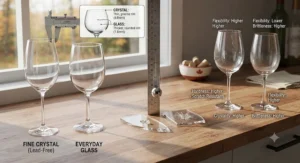
The pattern is clear: as rims get thinner, durability usually drops — except where engineering intervenes. The Schott Zwiesel Pure Burgundy and Luigi Bormioli Crescendo Bordeaux break that rule with Tritan and titanium treatments, which is why they deliver the best balance of performance and toughness. The Zalto Denk’Art Universal sits at the opposite extreme, sacrificing robustness for pure tasting precision.
Practical Usage Guide: Caring for Crystal or Glass Wine Glasses
Buying the right set is half the job. Keeping it clear, unchipped and unbroken is the other half — and it’s where most glassware dies young.
First use
- ✅ Wash every new glass before its first pour to remove packaging dust and cardboard aromas.
- ✅ If you own traditional lead crystal, Health Canada suggests soaking new pieces in vinegar for 24 hours before first use (more on that in the safety section).
Dishwasher routine (glass and lead-free crystal)
- ✅ Load stems on the top rack, spaced so nothing touches. Riedel specifically warns that contact with other items is the leading cause of dishwasher breakage.
- ✅ Use a stemware holder or clip if your rack allows it.
- ✅ Skip heavy-duty or pots-and-pans cycles; high heat and aggressive detergent speed up etching.
- ✅ Open the door at the end of the cycle and hand-dry with a microfibre cloth to prevent spots, especially in hard-water regions like much of southern Ontario and the Prairies.
Hand-washing (hand-blown crystal and lead crystal)
- ✅ Warm water, a drop of mild dish soap, and a soft sponge or bowl brush.
- ✅ Hold the bowl, never the base, when washing and drying. The number-one way thin stems snap is twisting the base and bowl in opposite directions.
- ✅ Dry immediately with a polishing cloth.
Common mistakes in the first 30 days
- ❌ Storing glasses upside down on the rim for long periods — it traps odours and puts stress on the thinnest point.
- ❌ Pouring hot water into cold crystal, which risks thermal shock.
- ❌ Leaving wine to dry overnight; tannins and acids stain and etch.
Think of crystal like a good chef’s knife: a little routine care keeps it performing for a decade.
Real-World Scenarios: Which Set Fits Your Life?
Specs are abstract until you picture your own kitchen. Here are three common Canadian profiles and the reasoning behind each match.
Profile 1: The busy family in Calgary
Two kids, a dog, a dishwasher running daily, and wine maybe three nights a week. Budget: under C$60. Breakage is inevitable here, so the Libbey Signature Kentfield Estate is the logical call. It’s lead-free, dishwasher tough, and replacing one glass won’t spark a family meeting. If the budget stretches, the Schott Zwiesel Pure Burgundy offers crystal clarity without extra fussing.
Profile 2: The Toronto condo host
Hosts dinner parties twice a month for eight to ten guests, limited cupboard space, wants the table to look polished. Budget: C$100-C$200. The Luigi Bormioli Crescendo Bordeaux fits beautifully — titanium-treated stems survive enthusiastic guests, and two sets of four cover a full table. Alternatively, a Riedel Vinum Cabernet/Merlot value pack delivers eight glasses with a recognizable silhouette.
Profile 3: The Niagara wine-country enthusiast
Visits wineries, keeps a small cellar, tastes critically, drinks a bit less but better. Budget: C$200-C$400. Here the Zalto Denk’Art Universal earns its price — one shape handles Riesling, Chardonnay and Cabernet Franc, and the ultra-thin rim reveals subtle aromatics. Hand-washing isn’t a chore for someone who already decants.
Notice the throughline: frequency of use and breakage risk matter more than wine knowledge when choosing crystal or glass wine glasses.

Problem → Solution: Fixing the Most Common Stemware Headaches
Every wine drinker eventually meets one of these problems. Here’s how to solve each.
Problem 1: Cloudy glasses after months of dishwasher use. First, test whether it’s removable. Soak a glass in white vinegar for 15 minutes. If it clears, it was mineral buildup from hard water — use a rinse aid and lower the water temperature. If it stays cloudy, it’s permanent etching. The long-term fix is switching to an etch-resistant material like the Tritan in the Schott Zwiesel Pure Burgundy.
Problem 2: Stems keep snapping. Almost always a drying-technique issue. Hold the bowl, not the base, and never twist. If breakage continues, move to reinforced stems like the Luigi Bormioli Crescendo Bordeaux.
Problem 3: Wine smells “off” or dusty. Glasses stored in cardboard boxes or wooden cabinets absorb odours. Rinse with water before serving, and store glasses upright in a ventilated cabinet.
Problem 4: Glasses don’t fit the cupboard. Large Bordeaux and Burgundy bowls often exceed 24 cm. Measure your shelf height before buying — the Libbey Signature Kentfield Estate and Zalto Denk’Art Universal are slightly shorter than the Waterford Elegance Cabernet Sauvignon.
Problem 5: You own inherited lead crystal and aren’t sure it’s safe. Use it for serving only, never storage, and follow the Health Canada precautions covered below.
✨ Don’t Miss These Exclusive Deals! 🔍
Take your wine nights to the next level with these carefully selected glasses. Click on any highlighted item to check current pricing and availability. These picks will help you create memorable, aroma-rich pours your guests will love!
What Is the Difference Between Crystal and Glass Stemware?
The difference between crystal and glass stemware comes down to chemistry, which then shapes everything else.
Most everyday wine glasses are made from soda-lime glass — sand (silica), soda ash and limestone. It’s inexpensive, non-porous, chemically stable and easy to recycle. Its limitation is that it’s relatively brittle, so manufacturers keep walls and rims thicker to avoid chipping.
Crystal adds minerals to the glass recipe. Historically that meant lead oxide — lead glass with high lead content has been prized for centuries because it’s easier to work, heavier and more light-refracting. Wine Folly notes crystal can contain anywhere from about 2% to 30% minerals, and standards differ by country; in Europe, “full lead crystal” must meet specific minimum percentages.
Today, most wine-focused brands use lead-free crystal, replacing lead with titanium, zinc, barium or zirconium. The result keeps crystal’s key advantage — strength that allows ultra-thin walls — without the lead.
Crystal vs Glass Compared to Traditional Alternatives
| Feature | Soda-Lime Glass | Lead-Free Crystal | Traditional Lead Crystal | Best For |
|---|---|---|---|---|
| Rim thickness | Thicker | Thin | Thin | Crystal for tasting precision |
| Sparkle/clarity | Good | Very high | Highest | Lead crystal for display |
| Dishwasher safe | Yes | Usually yes | No — hand-wash | Glass or lead-free crystal |
| Safety concerns | None | None | Avoid storage, extra care | Lead-free for daily use |
| Typical price per stem | C$8-C$15 | C$12-C$60 | C$50-C$150+ | Glass for budget |
The table shows why lead-free crystal has become the default recommendation for most Canadian households: it captures most of the tasting and visual benefits of traditional crystal while matching glass on dishwasher convenience. Traditional lead crystal still wins on sparkle and heirloom value, but the care and safety requirements make it a special-occasion material rather than a daily one.
Is Crystal Better Than Glass for Wine?
So, is crystal better than glass for wine? For most drinkers, yes — but not for the mystical reasons marketing sometimes implies.
The advantage is mostly physical. A thin crystal rim lets wine flow smoothly onto your tongue without a “lip” of glass interrupting it. That changes the sensation of the sip, which your brain folds into your perception of flavour. A lighter glass also feels more refined, and research on sensory perception consistently shows that context shapes taste.
Crystal’s strength also allows larger, more precisely shaped bowls. A generous bowl gives more surface area for aromatics to collect, and a tapered rim concentrates those aromas toward your nose. Since most of what we call “taste” is actually smell, this is where the real performance gain lives.
What crystal does not do is change the wine chemically. The minerals don’t interact with your wine in any meaningful flavour sense (lead leaching is a safety matter, not a taste one). A well-shaped, thin soda-lime glass will outperform a thick, badly shaped crystal one every time.
Here’s the practical conclusion: shape and rim thickness matter more than the word “crystal” on the box. That’s why a budget crystal like the Spiegelau Vino Grande Bordeaux delivers a bigger leap from the Libbey Signature Kentfield Estate than jumping from Spiegelau to the far pricier Waterford Elegance Cabernet Sauvignon. The first upgrade changes the experience; the later ones refine it.
Glassware Durability: What Actually Breaks and Why
Glassware durability is where the crystal-versus-glass debate gets surprisingly counterintuitive.
Material strength vs thickness
Crystal is intrinsically stronger than soda-lime glass, but manufacturers use that strength to make it thinner. So a crystal glass isn’t necessarily more resistant to knocks than a thick Libbey — it’s simply as strong at a fraction of the thickness. Drop both on tile and the thicker glass is often the survivor.
The three enemies of stemware
- Torsion — twisting during drying snaps stems. This is the leading cause of breakage in reviews across nearly every brand.
- Abrasion — microscopic scratches from dishwashers or cabinet shelves create fracture starting points. Titanium treatments like those on the Luigi Bormioli Crescendo Bordeaux target this.
- Etching — detergent slowly corrodes the surface, causing cloudiness. Tritan crystal in the Schott Zwiesel Pure Burgundy is formulated to resist this.
Durability ranking (based on construction)
- Most durable: Schott Zwiesel Pure Burgundy, Libbey Signature Kentfield Estate, Luigi Bormioli Crescendo Bordeaux
- Middle ground: Spiegelau Vino Grande Bordeaux, Riedel Vinum Cabernet/Merlot
- Handle with care: Waterford Elegance Cabernet Sauvignon, Zalto Denk’Art Universal
Here’s the takeaway: if you have young children or a cramped kitchen, choose engineered durability over thinness. A glass that survives is worth more than one that shatters beautifully.

Price Difference Crystal vs. Glass: Long-Term Cost Analysis
The sticker shock is real. The price difference crystal vs. glass buyers face can easily reach 10 times per stem. But cost per use tells a different story.
Five-Year Price & Value Analysis
| Product | Approx. Cost per Stem (CAD) | Estimated Breakage Risk | Est. 5-Year Cost per Stem* | Best For |
|---|---|---|---|---|
| Libbey Signature Kentfield Estate | C$9-C$14 | Moderate | C$15-C$25 | Libbey Signature Kentfield Estate: lowest total cost |
| Spiegelau Vino Grande Bordeaux | C$11-C$19 | Moderate | C$20-C$35 | Spiegelau Vino Grande Bordeaux: best crystal value |
| Schott Zwiesel Pure Burgundy | C$17-C$25 | Low | C$20-C$30 | Schott Zwiesel Pure Burgundy: long-term ROI |
| Zalto Denk’Art Universal | C$80-C$120 | Higher | C$120-C$200 | Zalto Denk’Art Universal: enthusiasts only |
*Estimates assume occasional replacements over five years; your mileage will vary with habits and household.
The numbers reveal a surprising winner. The Schott Zwiesel Pure Burgundy costs more upfront than the Libbey Signature Kentfield Estate, but low breakage and resistance to clouding bring its five-year cost close to budget glass. The Zalto Denk’Art Universal only makes financial sense if the tasting experience is the whole point.
Consider cost per use too. A C$20 glass used three times a week for five years works out to roughly 2-3 cents per pour — less than the cork. Glassware is one of the cheapest upgrades in the wine world.
The Sound/Ring Test and Other Ways to Tell Crystal From Glass
Inherited a box of stemware from Grandma? Here’s how to identify what you’ve got.
1. The sound/ring test
Gently flick the rim with your fingernail, or run a damp finger around the edge. Crystal typically produces a sustained, bell-like ring that lingers for a second or more. Soda-lime glass gives a short, dull “clink.” The denser and more mineral-rich the crystal, the longer and purer the tone. It’s not laboratory-grade proof, but it’s the quickest home test.
2. The light test
Hold the glass to a window or bright lamp. Crystal refracts light into small rainbow flashes; glass looks clear but flatter.
3. The weight test
Traditional lead crystal feels heavier than you’d expect for its size. Lead-free crystal, by contrast, is often lighter than comparable glass because walls are thinner — so weight alone isn’t decisive.
4. Rim thickness
Look at the rim in profile. A razor-thin, cut rim suggests crystal; a rounded, “rolled” lip is typical of glass.
5. Markings and packaging
Brands often etch a logo on the base. Old European crystal may bear a percentage stamp like “24% PbO,” indicating lead content.
If the sound/ring test and light test both suggest crystal, and the piece is vintage, assume it could contain lead and treat it accordingly.
How to Choose Crystal vs Glass Wine Glasses
Use these seven steps to narrow your choice quickly:
- Count your weekly pours. Daily drinkers benefit most from durability and dishwasher safety; occasional drinkers can prioritize elegance.
- Be honest about washing. If everything goes in the dishwasher, choose glass or lead-free crystal like the Schott Zwiesel Pure Burgundy.
- Assess breakage risk. Kids, pets, hard floors or small kitchens favour thicker glass or reinforced stems.
- Match shape to your wine. Mostly bold reds? Choose a Bordeaux bowl. Drinking everything? A universal shape is more efficient.
- Check rim thickness. This single spec impacts drinking experience more than the material label.
- Measure storage space. Big bowls need tall cabinets.
- Decide your total budget, then buy one extra. Always keep a spare to replace the inevitable casualty.
Following this framework makes crystal vs glass wine glasses a practical decision rather than a status one.
Safety and Regulations: Lead Crystal in Canada
Lead-free crystal and ordinary glass raise no special health concerns. Traditional lead crystal is different, and Canadian guidance is clear.
Health Canada’s advice on lead crystalware explains that lead can migrate from crystal into food and drinks, and that migration increases with acidity and contact time. Wine is acidic, so this matters.
Key Health Canada recommendations
- ✅ Never store wine, spirits or juice in lead crystal decanters or glasses. Use them for serving only.
- ✅ Avoid lead crystal for infants, children and pregnant people, since lead can pass to developing babies and nursing infants.
- ✅ Hand-wash gently with warm water and mild detergent; surface damage can increase lead release.
- ✅ Soak new lead crystal in vinegar for 24 hours before first use.
Canada also regulates lead in glassware through its Glazed Ceramics and Glassware Regulations under the Canada Consumer Product Safety Act. For broader context on lead exposure, Health Canada’s lead information package answers common questions about sources and health effects.
The practical takeaway: all seven products in this guide are either glass or marketed as lead-free crystal, with the exception of the Waterford Elegance Cabernet Sauvignon, whose composition isn’t clearly listed online. If lead status matters, confirm before purchase.
Features That Actually Matter (And Those That Don’t)
Glassware marketing is full of buzzwords. Here’s how to filter them.
Features that matter
- ✅ Rim thickness — the biggest single factor in how wine feels in your mouth.
- ✅ Bowl size and shape — larger bowls collect more aroma; tapered rims focus it.
- ✅ Dishwasher resistance — Tritan and titanium treatments offer real, measurable longevity.
- ✅ Stem construction — pulled stems and reinforced stems break less often.
- ✅ Lead-free status — essential for daily use and family households.
Features that matter less than you’d think
- ❌ “Hand-blown” on its own — beautiful and often lighter, but modern machine-made crystal is extremely precise and more consistent.
- ❌ Hyper-specific varietal glasses — unless you drink one style constantly, a universal glass covers 90% of needs.
- ❌ Heavy decorative cutting — looks stunning on the shelf but obscures the wine’s colour and adds weight.
- ❌ Stemless as an upgrade — convenient, but your hand warms the wine and fingerprints cloud the view.
The smart buyer spends on rim, shape and durability first, then prestige.

FAQ
❓ Are crystal or glass wine glasses better for everyday use?
❓ Where can I buy crystal wine glasses in Canada?
❓ How much should I spend on a good set of wine glasses?
❓ Can I put lead-free crystal wine glasses in the dishwasher?
❓ Are expensive wine glasses worth it as a gift?
Conclusion: Crystal vs Glass Wine Glasses — The Smart Choice for Your Table
The crystal vs glass wine glasses debate doesn’t have a single winner — it has the right match for your habits. If breakage and budget dominate your life, the Libbey Signature Kentfield Estate delivers honest, dishwasher-tough performance for very little money. If you want the most noticeable upgrade for the least cash, the Spiegelau Vino Grande Bordeaux puts thin-rimmed crystal on your table at nearly glass prices.
For hosts, the Luigi Bormioli Crescendo Bordeaux and Schott Zwiesel Pure Burgundy strike the best balance of elegance and toughness, with engineered stems and etch-resistant crystal that shrug off daily use. Red wine devotees will appreciate the classic shaping of the Riedel Vinum Cabernet/Merlot, while the Waterford Elegance Cabernet Sauvignon remains a memorable gift. And if tasting is your passion, the Zalto Denk’Art Universal offers a lightness that’s hard to forget.
Remember the core lessons: rim thickness and bowl shape matter more than labels, lead-free crystal is the practical sweet spot, and traditional lead crystal belongs in the serving-only category per Health Canada. Choose for how you actually live, and every pour will feel a little more special.
🍷 Ready to raise your glass? 👉
Click any highlighted product above to check current pricing and availability on amazon.ca — and find the set that turns your next bottle into an occasion worth savouring!
Recommended for You
- Crystal Wine Glasses For Red Wine: 7 Best Picks (2026)
- 7 Best Lead-Free Crystal Wine Glasses In Canada (2026)
- Handblown Crystal Wine Glasses: 7 Best Picks Ranked (2026)
Disclaimer: This article contains affiliate links. As an Amazon Associate, I earn from qualifying purchases. If you purchase products through these links, we may earn a small commission at no additional cost to you.
✨ Found this helpful? Share it with your friends! 💬🤗
