
In This Article
Somewhere between “any glass will do” and “I need a $300 crystal goblet to enjoy a Tuesday-night Malbec” lies the truth about stemmed wine glasses: the vessel actually changes how the wine tastes. Not in a mystical way — in a measurable, physics-and-chemistry way. A bowl shaped to funnel aroma toward your nose genuinely makes a $15 bottle of red taste rounder. A stem long enough to keep your palm off the bowl keeps a chilled Pinot Grigio from turning lukewarm by your third sip. It’s a small thing that adds up to a noticeably better night.

Stemmed wine glasses are a category of stemware built with a base, a long thin stem, and a bowl positioned above your hand, and they remain the standard for serious wine service because the stem prevents body heat from warming the wine and keeps fingerprints off the bowl. That’s the whole design philosophy in one sentence, and it’s why sommeliers still reach for stems even as stemless glasses have taken over casual dinner tables.
This guide walks through seven real, currently available stemmed wine glass sets sold on Amazon.ca — from a $25ish weeknight workhorse to genuine European crystal — plus honest analysis of what separates a good set from a gimmick. We’ll also dig into where to actually get a stemmed wine glasses set of 6 under $60 CAD, how bulk glassware sets differ from boutique ones, smart wine glass storage racks, and what “restaurant-style stemware” really means for a home bar. Everything here is grounded in real specs and aggregated review sentiment — no invented tasting notes, no fabricated five-star quotes.
Quick Comparison Table: Stemmed Wine Glasses at a Glance
| Product | Capacity | Material | Approx. Price (CAD) | Best For |
|---|---|---|---|---|
| Libbey Vina Balloon Stemmed Wine Glasses, Set of 6 | 18.25 oz | Machine-blown glass | C$35-C$45 range | Everyday hosting on a budget |
| Riedel Ouverture Red Wine Glasses, Set of 2 | 24 oz | Machine-made crystal | C$35-C$45 range | Entry-level “real crystal” upgrade |
| Schott Zwiesel Pure Cabernet Wine Glasses, Set of 6 | 18 oz | Tritan crystal glass | C$70-C$90 range | Dishwasher-proof premium daily use |
| JoyJolt Layla White Wine Glasses, Set of 4 | 13.5 oz | Lead-free glass | C$25-C$35 range | Small-batch white wine drinkers |
| AMYOOLE Hand-Blown Red Wine Glasses, Set of 4 | 15 oz | Lead-free crystal | C$30-C$40 range | Gifting and special occasions |
| Bormioli Rocco Restaurant-Style Stemware (Premium Collection) | 16-18 oz | Commercial-grade glass | C$40-C$55 range | Restaurant-style durability at home |
| AW Bridal Mr. and Mrs. Stemmed Wine Glasses, Set with Accessories | 12 oz | Lead-free crystal | C$25-C$35 range | Anniversary and wedding gifting |
Looking across the table, the split isn’t really “cheap vs. expensive” — it’s dishwasher-safe daily glass versus hand-wash-only crystal, and that’s the decision that actually matters for most Canadian kitchens. If you host often and don’t want to babysit stemware after every dinner party, the Schott Zwiesel Pure Cabernet and Libbey Vina sets do the heavy lifting. If you’re buying for a once-a-year anniversary toast, the AW Bridal set and AMYOOLE glasses punch well above their price in presentation.
💬 Just one click — help others make better buying decisions too!😊
Top 7 Stemmed Wine Glasses: Expert Analysis
1. Libbey Vina Balloon Stemmed Wine Glasses, Set of 6 — best all-rounder for everyday hosting
The Libbey Vina set is the one you buy when you want stems that look intentional without babying them like fine crystal. Each glass holds 18.25 oz, stands 8.9 inches tall, and uses a deep balloon-shaped bowl designed to give red wine room to swirl and breathe.
Libbey has been making glass in North America since 1818, and it shows in the consistency here — every glass in a six-pack is genuinely the same weight and thickness, which sounds obvious until you’ve dealt with a bargain set where two glasses wobble and four don’t. The pulled stem (meaning it’s shaped from the same piece of glass as the bowl, not fused on separately) is the detail that keeps this from feeling like cafeteria glassware despite the accessible price.
Reviewers consistently report that this set survives the dishwasher for years without clouding, which matters more than most buyers realize — cheap soda-lime glass etches and fogs under repeated hot-water cycles, while Libbey’s tempering process resists it noticeably longer. A common note in aggregated feedback is that the bowl is on the larger side, so pour conservatively if you’re used to smaller glasses.
This is the set for anyone who wants “nice” stemware for actual regular use — book club, Sunday dinners, the friend who drops by unannounced — rather than glasses reserved for a hutch.
Pros:
- ✅ Dishwasher-safe with strong resistance to clouding over time
- ✅ Consistent weight and balance across all six glasses
- ✅ Elegant balloon bowl works for reds, whites, or both
Cons:
- ❌ Bowl runs large, easy to overpour if unaccustomed
- ❌ Machine-made glass lacks the wafer-thin rim of true crystal
Priced in the C$35-C$45 range for a set of six, this is arguably the best value-per-glass on this list — check current price on Amazon.ca before buying, since Libbey runs frequent multi-buy promotions.

2. Riedel Ouverture Red Wine Glasses, Set of 2 — best entry point into real stemware crystal
Riedel is the name most wine drinkers recognize even if they’ve never bought a glass in their life, and the Riedel Ouverture line is explicitly positioned as the brand’s accessible tier — the set that lets you own “a Riedel” without spending Sommelier-line money.
At 24 oz, the bowl is generously proportioned for red wine, engineered with Riedel’s signature varietal-specific logic: a wider bowl concentrates aroma toward the nose before it hits your tongue. The machine-made crystal (as opposed to hand-blown) keeps the price down while still using Riedel’s shape research, which is really what you’re paying for with this brand.
Based on the spec comparison against other crystal entry points, what stands out is that Riedel deliberately kept the Ouverture line’s wall thickness a notch above their premium Sommeliers line — a trade-off that makes it more forgiving of everyday knocks. Aggregated reviews frequently mention that the rim, while not paper-thin, is noticeably finer than typical big-box glassware, and that the difference is obvious the first time you drink from it after years of standard glasses.
Who should care: anyone curious whether “the glass really changes the taste” wants to test that claim without committing to a full boxed set. Two glasses is enough to do a side-by-side comparison with a cheaper glass at home.
Pros:
- ✅ Recognizable, trusted brand backed by decades of shape research
- ✅ Noticeably thinner rim than mainstream glass alternatives
- ✅ Machine-made crystal keeps cost accessible for the name
Cons:
- ❌ Set of 2 only — you’ll need multiple sets for dinner parties
- ❌ Less shatter-resistant than tempered glass alternatives
Expect a price in the C$35-C$45 range for the pair, which puts each glass in premium territory — worth it if this is your first step into dedicated stemware.
3. Schott Zwiesel Pure Cabernet Wine Glasses, Set of 6 — best dishwasher-safe premium option
Schott Zwiesel solves the single biggest complaint about nice stemware: that you can’t put it in the dishwasher. This German-made 18 oz set uses Tritan crystal glass, a patented formula that adds titanium and zirconium oxide to standard crystal glass, making it both lead-free and genuinely dishwasher-durable.
What most buyers overlook about this brand is that “Tritan” isn’t a marketing buzzword — it’s a real material science difference that shows up as scratch resistance and long-term clarity retention that machine-blown soda-lime glass simply can’t match. The Cabernet shape has a slightly narrower opening than a standard balloon glass, designed to direct wine toward the front and sides of the tongue.
Reviewers who’ve owned other “premium” sets consistently point to this one as the rare product that lives up to both halves of its promise: it looks like proper crystal stemware and survives years of actual dishwasher use without clouding or dulling — a combination that’s genuinely hard to find at this price point.
If you’re the kind of host who refuses to hand-wash anything after 10 p.m. but still wants glasses that look considered rather than functional, this is the set that ends the debate.
Pros:
- ✅ Certified dishwasher-safe without long-term clouding
- ✅ Lead-free Tritan crystal for genuine clarity and durability
- ✅ German engineering with a well-documented track record
Cons:
- ❌ Higher upfront cost than standard glass sets
- ❌ Narrower bowl shape may feel small to big-glass drinkers
At around C$70-C$90 for a set of six, this sits at the top of this roundup’s price range — but the math changes when you factor in zero breakage from hand-washing accidents and no replacement cycle every couple of years.
4. JoyJolt Layla White Wine Glasses, Set of 4 — best for dedicated white wine drinkers
Most “wine glass” roundups default to red-wine-shaped glasses and call it a day, which is a disservice to anyone who actually drinks more Sauvignon Blanc than Cabernet. The JoyJolt Layla set is a 13.5 oz Italian-style glass purpose-built with a narrower bowl specifically for whites.
The narrower profile isn’t cosmetic — it reduces the wine’s surface area exposure to air, which slows the warming and oxidation that dulls a chilled white’s acidity and floral notes. JoyJolt is a newer North American glassware brand that’s built a strong catalogue specifically around clean, modern shapes rather than ornate cut crystal, and the Layla set reflects that minimalist approach.
Aggregated customer sentiment for this line skews toward praise for the glass’s light weight and clarity for the price, with a recurring note that the smaller 13.5 oz capacity feels restrained compared to the oversized 18-22 oz glasses that dominate this category — which, for white wine specifically, is arguably correct rather than a flaw.
This is the set for the household where white wine, not red, is the default pour — cottage weekends, seafood dinners, or anyone who’s decided that oversized glasses just mean warmer wine by the last sip.
Pros:
- ✅ Purpose-built narrow bowl preserves chilled white wine’s aromatics
- ✅ Lightweight glass that’s comfortable for extended sipping
- ✅ Clean, modern silhouette that photographs well for entertaining
Cons:
- ❌ Set of 4 only, awkward for parties larger than a dinner table
- ❌ Smaller capacity means more frequent refills for generous pourers
Set of 4 typically runs in the C$25-C$35 range, making it one of the more accessible entries here — a smart pickup if your wine rack skews white and rosé.
5. AMYOOLE Hand-Blown Red Wine Glasses, Set of 4 — best gift-ready crystal on a budget
The AMYOOLE set punches above its price by leaning into presentation: hand-blown Italian-style construction, a 15 oz bowl, a long elegant stem, and gift packaging that doesn’t scream “bought last-minute.”
Hand-blown glass, unlike machine-pressed glass, means each piece passes through a human glassblower’s process, which introduces tiny natural variations — a slightly different curve here, a subtle asymmetry there — that collectors actually associate with quality rather than defect. AMYOOLE markets this set as lead-free crystal, meaning it gets the clarity and ring associated with crystal without the lead-oxide content that older crystal traditionally used.
What the spec sheet won’t tell you, but reviewers note, is that hand-blown glass sets like this one tend to run slightly less uniform in weight from glass to glass compared to machine-made sets like Libbey’s — a trade-off buyers seem willing to accept in exchange for the “real crystal” feel and gifting presentation.
This is the pick for a wedding gift, a housewarming, or simply someone who wants their everyday glass to look a step above what’s in most kitchen cabinets, without the wait time or price tag of a big-name crystal house.
Pros:
- ✅ Hand-blown construction gives genuine crystal character
- ✅ Gift-ready packaging suited for weddings and anniversaries
- ✅ Lead-free formulation avoids older crystal’s lead-oxide content
Cons:
- ❌ Slight weight variation between individual glasses is common
- ❌ Hand-wash recommended to preserve the thin rim over time
Sets typically land in the C$30-C$40 range for four glasses — a reasonable ask for something that reads as considerably more expensive than it is.

6. Bormioli Rocco Restaurant-Style Stemware (Premium Collection) — best for restaurant-style durability at home
If you’ve ever wondered why the stemware at a busy Italian restaurant never seems to chip despite constant handling, the answer is often Bormioli Rocco — an Italian glassware manufacturer that’s been supplying commercial foodservice since the early 1900s and has quietly become a go-to for home cooks who want that same battle-tested resilience.
This restaurant-style stemware collection runs 16-18 oz depending on the exact line, built with a reinforced rim and thicker stem-to-bowl junction — the single point where most home stemware actually fails. Commercial glassware is engineered differently from boutique home sets: foodservice glass is designed around a stacking, high-turnover, constant-handling reality, which means the tolerances for chipping and stress-cracking are simply tighter.
Reviewers who’ve compared this to more delicate home sets consistently flag the trade-off honestly: it’s a touch heavier in hand than boutique crystal, but it survives the kind of use — kids’ birthday parties doubling as adult happy hour, big family dinners, glasses stacked two deep in a dish rack — that would eventually claim a fine crystal set.
Who this is for: anyone who’s tired of replacing broken stemware every year, or who genuinely wants glasses that could survive a restaurant kitchen because, functionally, that’s exactly what they’re built for.
Pros:
- ✅ Commercial-grade reinforcement at the highest-stress point of the glass
- ✅ Proven track record in actual restaurant and foodservice settings
- ✅ Excellent chip resistance for households with heavy glass turnover
Cons:
- ❌ Slightly heavier feel than boutique or crystal alternatives
- ❌ Less refined bowl shaping than varietal-specific glasses
Expect a price in the C$40-C$55 range depending on set size — solid value once you price in how much less often you’ll be replacing broken glasses.
7. AW Bridal Mr. and Mrs. Stemmed Wine Glasses, Set with Accessories — best for anniversaries and milestone gifting
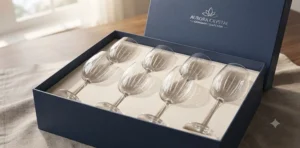
Not every entry on a “best stemmed wine glasses” list needs to be about daily use — sometimes you’re shopping for a specific moment, and the AW Bridal set is built entirely around that occasion. Each 12 oz glass is made with traditional glassblowing techniques using lead-free crystal, packaged with a wine opener and stopper inside a pine keepsake box with a latch closure.
The presentation is genuinely the product here: this isn’t a generic two-glass set with a bow taped on, it’s a self-contained gift with cushioned packaging that survives shipping and looks considered the moment it’s opened. Because it’s dishwasher-safe crystal rather than delicate hand-wash-only glass, it also holds up as a set the couple can actually use afterward rather than one that gets shelved as decoration.
Aggregated reviews are consistently positive on the presentation and gifting angle specifically, with buyers noting it reads as more thoughtful than a standard glass-and-card combination — though a few flag that the 12 oz capacity is modest if the couple plans to use these as their everyday stemware rather than an occasion set.
This is the pick when the glass itself matters less than what it represents — anniversaries, engagement gifts, or a couple’s first holiday season together.
Pros:
- ✅ Complete gift set with opener, stopper, and keepsake box included
- ✅ Dishwasher-safe despite the crystal presentation
- ✅ Genuinely gift-appropriate packaging that survives shipping well
Cons:
- ❌ 12 oz capacity is smaller than most everyday wine glasses
- ❌ More of an occasion gift than a full daily-use replacement set
Priced in the C$25-C$35 range with accessories included, this is honestly a strong value once you account for the opener and stopper bundled in.
Top 7 Products Comparison: Specs & Value
| Product | Capacity | Dishwasher-Safe | Material Type | Price Range (CAD) | Best For |
|---|---|---|---|---|---|
| Libbey Vina | 18.25 oz | Yes | Machine-blown glass | C$35-C$45 | Everyday hosting |
| Riedel Ouverture | 24 oz | Hand-wash recommended | Machine-made crystal | C$35-C$45 | First crystal upgrade |
| Schott Zwiesel Pure Cabernet | 18 oz | Yes (certified) | Tritan crystal glass | C$70-C$90 | Dishwasher-proof premium |
| JoyJolt Layla | 13.5 oz | Yes | Lead-free glass | C$25-C$35 | White wine drinkers |
| AMYOOLE Hand-Blown | 15 oz | Hand-wash recommended | Lead-free crystal | C$30-C$40 | Gifting |
| Bormioli Rocco Restaurant-Style | 16-18 oz | Yes | Commercial-grade glass | C$40-C$55 | Heavy-use households |
| AW Bridal Gift Set | 12 oz | Yes | Lead-free crystal | C$25-C$35 | Anniversary gifting |
Looking at the full comparison, the dividing line isn’t price so much as maintenance tolerance: three of these seven sets are explicitly built to survive dishwashers indefinitely, while the Riedel Ouverture and AMYOOLE sets trade some of that durability for a thinner, more refined rim. If your household actually hand-washes stemware consistently, that trade is worth making; if realistically nothing in your kitchen gets hand-washed after 9 p.m., stick to the dishwasher-certified three.
✨ Ready to pick a set? Scroll down for the buyer’s framework that matches each type of drinker to the right glass.
Set Sizes: 6-Packs Under $60 CAD vs. Bulk Glassware
Stemmed Wine Glasses Set of 6 Under $60 CAD: What’s Actually Available
This is one of the most searched configurations for a reason — a set of six is the sweet spot for most Canadian households: enough for a dinner party of four with two spares for breakage, without the storage headache of a 12-piece box.
At the sub-C$60 mark, the Libbey Vina Balloon set of 6 is the clearest winner on this list, typically landing in the C$35-C$45 range while still delivering a genuinely elegant balloon bowl and dishwasher durability. Bulk retailers and Amazon.ca third-party sellers also frequently list generic lead-free crystal six-packs (often unbranded or house-brand) in the C$30-C$50 range — these can be perfectly serviceable, but based on the spec comparison across listings, the trade-off is usually thinner quality control: expect more weight and clarity variation glass-to-glass than you’d get from an established manufacturer like Libbey or Bormioli Rocco.
Here’s what to weigh before clicking “buy” on a bargain set-of-6: check the stated capacity carefully, since some budget listings advertise “large” glasses that turn out to be 10-12 oz once you read the fine print, and confirm dishwasher-safety in the listing rather than assuming it, since not every lead-free crystal set is rated for machine washing.
Bulk Glassware Sets: When 6 Isn’t Enough
Bulk glassware sets — typically 12, 18, or 24 pieces — solve a different problem than a boutique set of 4 or 6: they’re built for volume events, rental situations, or households that entertain often enough that breakage attrition is a real planning factor, not a hypothetical.
Reviewers consistently note that the calculus changes once you’re buying in bulk. A common complaint in aggregated feedback on bulk sets is inconsistent quality control across a large box — a 24-piece set is more likely to include a handful of glasses with minor stem asymmetry or bowl thickness variance than a curated 4- or 6-piece boutique box, simply because bulk manufacturing runs prioritize volume over piece-by-piece inspection.
Based on the spec comparison, Libbey and Bormioli Rocco both offer restaurant-and-bulk-oriented lines specifically because their foodservice divisions already manufacture at that scale — buying their bulk consumer sets often means getting foodservice-grade consistency at a home-shopper price point, which isn’t true of every bulk listing on Amazon.ca. If you’re hosting a wedding, running a small event-rental side business, or simply refuse to run out of clean glasses mid-party, a 12+ piece set from an established manufacturer is worth the modest price premium over an unbranded bulk listing.
Wine Glass Storage Racks: Protecting Your Investment
Buying good stemware and then jamming it into a cluttered cupboard is how a $70 set becomes a $50 set with two chipped rims by spring. Wine glass storage racks — whether under-cabinet hanging racks, stemware cabinets, or dedicated stacking crates — exist specifically to solve the storage problem that causes most home stemware breakage in the first place.
Under-cabinet hanging racks store glasses upside-down by the foot, which keeps dust out of the bowl and, more importantly, keeps the fragile rim from resting against a hard shelf surface — the single most common chip point on any stemmed glass. Stacking crates (often the same style used by wine cellars and restaurants) work well for bulk sets, cushioning each glass’s foot against the one below it rather than letting bowls knock together in a drawer.
Here’s what most buyers overlook when shopping for storage: rack spacing matters as much as rack material. A rack sized for standard 8-9 inch stems will damage the taller 24 oz Riedel-style glasses on this list if you force them in, so measure your tallest glass before ordering. For mixed collections — say, the shorter JoyJolt Layla alongside the taller Riedel Ouverture — an adjustable-slot rack or open-shelf stemware cabinet is a safer bet than a fixed-peg hanging rack.
Restaurant-Style Stemware: What the Term Actually Means
“Restaurant-style stemware” gets thrown around loosely in product listings, but it has a real, specific meaning in the glassware industry: it refers to commercial-grade glass engineered for high-volume handling, stacking, and constant dishwasher cycling — not simply “glasses that look fancy.”
The practical differences show up in three places. First, the rim is typically reinforced or slightly thicker at the point of contact, since restaurant glassware gets bussed, stacked, and racked dozens of times a day. Second, restaurant-style glasses are almost universally tempered or reinforced at the stem-to-bowl junction, the weakest point on any stemmed glass and the spot where most home breakage actually happens. Third, restaurant stemware is designed to stack — either bowl-to-bowl in a rack or nested in commercial glass racks — which home-oriented boutique sets are rarely built to do safely.
On paper this means a set like Bormioli Rocco’s restaurant-style collection trades a small amount of visual delicacy for real-world resilience — the same trade-off a busy bistro makes deliberately. For Canadian households that host often, have kids underfoot during dinner parties, or simply want glassware that survives being loaded into a dishwasher improperly by a well-meaning guest, that trade is usually worth making.
Practical Usage Guide: Setup, Care & Optimization
Getting a new set of stemmed wine glasses right starts before the first pour. Unbox each glass individually rather than stacking them straight from the shipping box — manufacturers pack stemware nested for shipping efficiency, not for how you should store it long-term, and separating them immediately reduces the odds of a chip from box-transit jostling.
For first use, hand-wash new crystal or lead-free crystal once before its first dishwasher cycle, even if the listing says dishwasher-safe; this removes manufacturing residue that can otherwise bake into the glass surface on the first hot cycle. When loading a dishwasher long-term, always place stemmed glasses on the top rack, angled slightly so water drains off the bowl rather than pooling at the base — pooled water combined with hard detergent is the leading cause of the cloudy “etching” look that ruins otherwise-good glassware over a year or two.
One practical note for the inevitable chip or break: unlike bottles and jars, broken stemware generally shouldn’t go in a curbside glass recycling bin, since drinking glasses and other glassware have a different chemical composition than container glass and can contaminate a load of recyclable bottles — check your municipality’s guidance before tossing broken pieces in the blue bin.
A common first-30-days mistake: storing glasses right-side up in a cupboard, which lets dust and cooking residue settle inside the bowl and traps moisture at the base. Store bowl-down on a soft shelf liner, or invest in the storage rack solutions covered above. For polishing, a microfiber cloth with a bit of steam (hold the glass over boiling water briefly, then wipe) removes water spots far better than a dry cloth alone — a trick borrowed directly from restaurant glass-polishing routines.
Real-World Scenario: Matching Glasses to How You Actually Drink
The weeknight-and-weekend host. If you pour wine three or four nights a week and host casually every couple of weekends, durability beats delicacy every time. The Libbey Vina or Schott Zwiesel Pure Cabernet sets are built for exactly this rhythm — dishwasher-safe, resilient, and elegant enough that you’re not embarrassed pulling them out for guests.
The white-wine-only household. If red barely makes an appearance in your kitchen, buying a standard balloon-bowl set is arguably the wrong move. The JoyJolt Layla set’s narrower bowl is specifically engineered to keep chilled whites from warming and oxidizing too fast — a real functional upgrade, not just a style choice.
The occasional-but-intentional entertainer. If wine glasses live in a cupboard 350 days a year and come out for anniversaries, milestone birthdays, or holiday dinners, the calculus flips: presentation and gift-worthiness matter more than dishwasher-cycle durability. The AW Bridal and AMYOOLE sets are built around exactly that use case, prioritizing how the set looks unboxed over how it survives a decade of daily handling.
How to Choose Stemmed Wine Glasses
- Match the bowl shape to what you actually drink. Wide balloon bowls suit reds by maximizing aeration; narrower bowls preserve chilled whites’ aromatics — buying the “universal” shape is a reasonable compromise if you drink both roughly equally.
- Decide your dishwasher tolerance honestly. If you know realistically nothing gets hand-washed in your house, only shortlist sets explicitly rated dishwasher-safe long-term, like Schott Zwiesel or Libbey, rather than assuming any glass will hold up.
- Check capacity against your actual pour size. A 24 oz glass filled to a proper one-third pour looks almost empty and can feel stingy; an 18 oz glass often reads as more generously filled at the same actual pour volume.
- Weigh lead-free crystal vs. standard glass. Lead-free crystal offers extra clarity and a satisfying “ring” when tapped, at a moderate price premium over standard glass — worth it for gifting, less critical for daily-use sets. All food-contact glassware sold in Canada, lead-free or not, is subject to migration limits on lead and cadmium under federal regulations, so any set sold new through Amazon.ca is already held to that baseline.
- Buy one or two extra glasses beyond your household size. Stemware breaks; buying six for a family of four means you’re not scrambling — or serving wine in a mug — the week two glasses chip.
- Consider stem height against your storage. A rack or cupboard sized for standard glasses may not fit the taller 24 oz Riedel-style stems — measure before you buy both the glass and the storage solution.
- Factor in resale-adjacent value for name brands. Recognizable names like Riedel and Schott Zwiesel hold gifting value and are easier to source replacement pieces for years later, which matters if you’re building a long-term collection rather than a one-off purchase.
Common Mistakes When Buying Stemmed Wine Glasses
The most frequent mistake is buying based on bowl size alone, assuming bigger automatically means better — in practice, an oversized bowl on a modest pour just means more wine surface area exposed to air, which can flatten a delicate white wine’s aromatics faster than a properly sized glass would.
A second common misstep is ignoring rim thickness entirely. What the spec sheet won’t tell you, but reviewers across multiple product lines consistently note, is that a thin, tapered rim genuinely changes the sipping experience — wine flows more precisely onto the tongue — while a thick, rolled rim (common on very cheap sets) can make even a good bottle taste blunter than it is.
Third, many buyers skip checking actual stem height against their existing storage or dishwasher rack clearance, only to discover their new 24 oz glasses don’t fit the dishwasher’s top rack or a hanging storage rack sized for shorter glasses. Finally, a subtler mistake: assuming “crystal” always means lead crystal. Most modern stemware marketed as crystal, including several sets on this list, is lead-free — worth confirming in the listing if lead content is a personal concern (more on that in the safety section below).
Stemmed Wine Glasses vs. Stemless Wine Glasses
The stemless glass has taken over a huge share of the casual glassware market over the past decade, and the debate between the two styles comes down to function versus convenience rather than one style being objectively better.
Stemmed glasses keep your hand off the bowl, which matters most for whites and sparkling wine that you want to stay cool, and the elevated bowl makes swirling to release aroma easier and less awkward. Stemless glasses trade that temperature control for stability and durability — no stem to snap off if knocked, and a lower center of gravity that’s genuinely harder to tip over, which is exactly why so many households default to them for casual weeknight drinking or backyard entertaining.
Based on the spec and use-case comparison, the honest answer for most Canadian households is “both” — stemmed glasses like the Libbey Vina or Schott Zwiesel set for dinner parties and gifting, stemless for the deck, the pool, or anywhere breakage risk is higher than usual. If you can only own one style, though, stemmed remains the more versatile choice: it performs better across more wine types, and nothing stops you from holding it by the bowl on a casual night if stability isn’t a concern.
Long-Term Cost & Maintenance
Total cost of ownership for stemware isn’t just the sticker price — it’s sticker price divided by realistic lifespan, and that math changes dramatically between the sets on this list. A C$35 Libbey Vina set that survives five years of regular dishwasher use without clouding works out to roughly C$1.20 per glass per year. A C$30 bargain crystal set that clouds within 18 months and needs replacing works out considerably worse despite the lower upfront cost.
Dishwasher-safe sets like Schott Zwiesel and Bormioli Rocco carry a real long-term cost advantage precisely because they remove the labour cost of hand-washing (time is worth something) and the breakage risk that comes with hand-washing delicate stems over a sink. Hand-wash-only sets like the Riedel Ouverture and AMYOOLE collections require more careful handling indefinitely, which is a fair trade for their thinner, more refined feel, but it’s an ongoing cost in attention, not just money.
Replacement piece availability matters too — established brands like Riedel and Libbey are far easier to buy single replacement glasses for years after your original purchase than boutique or unbranded bulk sets, which often get discontinued or swapped for a new SKU within a couple of seasons.
Safety, Lead Content & Canadian Regulations
Lead crystal has a long history in fine stemware because lead oxide increases clarity, weight, and the glass’s “ring” — but it also means the glass can leach small amounts of lead into liquids, particularly if it’s used for prolonged storage rather than simple serving. Health Canada explains that lead crystalware can release lead into food and beverages it comes into contact with, and recommends against storing beverages in lead crystal decanters for extended periods, using crystal only for serving rather than storage.
The good news for anyone shopping this list specifically: most of the sets featured here — including the JoyJolt, Schott Zwiesel, AW Bridal, and AMYOOLE collections — are explicitly marketed as lead-free crystal or lead-free glass, meaning they achieve clarity and weight through alternative formulations (like Schott Zwiesel’s titanium-and-zirconium Tritan process) rather than traditional lead oxide. If you’re buying vintage or inherited stemware rather than a new set, that’s where the actual risk calculus changes, since older pieces predate current lead-free manufacturing standards.
Glazed ceramic and glassware sold in Canada also falls under the Canada Consumer Product Safety Act and its associated Glazed Ceramics and Glassware Regulations, which set migration limits on lead and cadmium release from food-contact glassware — a regulatory backstop that applies regardless of which brand you ultimately choose.
Problem → Solution Guide
Problem: Glasses keep coming out cloudy from the dishwasher. Solution: switch to a rinse-aid-only cycle without heated dry, and confirm your detergent isn’t a harsh “sanitizing” formula — those accelerate the etching that causes permanent cloudiness on both crystal and standard glass.
Problem: Stems keep snapping during hand-washing. Solution: wash one glass at a time rather than several in a full sink, and dry with a soft cloth rather than air-drying stacked, since stacked wet stems are a common breakage point.
Problem: Storage space is too tight for a full 12-piece set. Solution: a compact set of 6 like the Libbey Vina or JoyJolt Layla, paired with an adjustable wine glass storage rack, solves the space problem better than a bulk set most condo kitchens can’t accommodate.
Problem: Wine tastes flat or warm by the second glass. Solution: check bowl size against your actual pour — an oversized bowl exposes more surface area to warm room air; switching to a narrower-bowl set like JoyJolt Layla for whites specifically addresses this.
Problem: Mismatched glassware from years of breakage-replacement. Solution: standardize on a brand with strong replacement-piece availability, like Libbey or Riedel, so future top-ups actually match rather than compounding the mismatch.
✨ Ready to fix your glassware lineup for good? Take a look at the picks above and start with whichever solves your specific problem first.
Buyer’s Decision Framework
If you host often and hate hand-washing, choose a certified dishwasher-safe set like Schott Zwiesel or Libbey, because long-term convenience will outweigh the marginal difference in rim thinness.
If you’re buying a gift for a wedding, anniversary, or housewarming, choose a presentation-forward set like AW Bridal or AMYOOLE, because unboxing experience and gift-worthiness matter more than daily-use durability for a one-time purchase.
If your household drinks mostly white wine or rosé, choose a narrower-bowl set like JoyJolt Layla, because the shape genuinely preserves chilled wine’s aromatics better than a red-wine-shaped balloon bowl.
If you entertain in large groups or run events, choose a bulk or restaurant-style set from an established foodservice-adjacent brand like Bormioli Rocco, because commercial-grade reinforcement will survive high-volume handling that boutique sets aren’t built for.
If budget is the primary constraint and you want six good glasses without compromise, choose the Libbey Vina set, because it delivers the best balance of price, durability, and visual polish on this list.
Features That Actually Matter (And Those That Don’t)
What to Expect: Real-World Performance
On paper, the specs across this list look fairly similar — most sets cluster between 13 and 24 oz, most claim some form of dishwasher safety, most use the word “crystal” somewhere in their listing. In practice, the differences show up gradually, not immediately.
A cheap glass and a well-made one both look identical out of the box. The gap appears around month six to twelve: the cheap glass starts showing faint cloudiness after repeated dishwasher cycles, the rim develops a slightly rougher feel from micro-chipping, and the stem starts to feel loose-jointed compared to day one. A well-made set from an established manufacturer like Libbey, Riedel, or Schott Zwiesel tends to look and feel essentially unchanged at the one-year mark under identical use.
The other real-world difference reviewers consistently flag is how the glass performs during actual use, not just storage — a properly shaped bowl noticeably changes how aroma reaches your nose on the first sip, something that’s genuinely hard to appreciate from a product photo but becomes obvious the moment you drink from a well-designed glass after years of generic ones.
Actually matters: dishwasher-safety rating (if that’s how you’ll wash them), bowl shape matched to your primary wine type, and rim thinness, which measurably affects the drinking experience. Also genuinely useful: brand replacement-piece availability, since breakage is a when, not an if.
Doesn’t matter nearly as much as marketing suggests: elaborate cut-crystal patterns, which look nice but add nothing to how the wine tastes and often make glasses harder to clean thoroughly. Also overrated: extremely tall stems purely for visual drama — past a certain height, a taller stem just adds tipping risk without any functional benefit to the wine itself. And despite what some listings imply, “hand-blown” doesn’t automatically mean better than “machine-made” — it means more character and slight variation, which is a legitimate aesthetic preference, not an objective upgrade in performance.

Frequently Asked Questions
❓ What's the difference between stemmed and stemless wine glasses?
❓ Are stemmed wine glasses dishwasher safe?
❓ How many stemmed wine glasses should I own?
❓ What size are standard stemmed wine glasses?
❓ Is lead-free crystal actually safe?
Conclusion
Stemmed wine glasses aren’t just about looking the part at the dinner table — the shape, rim thickness, and material genuinely change how a bottle tastes and how long your glassware lasts. Across this list, the Libbey Vina set remains the strongest all-around pick for most Canadian households, balancing price, durability, and everyday elegance without asking you to babysit it. If dishwasher-proof longevity matters more than anything else, Schott Zwiesel’s Pure Cabernet set earns its higher price tag. And if you’re shopping for a gift rather than your own kitchen, AW Bridal or AMYOOLE deliver presentation that punches well above their cost.
Whichever set you land on, the details covered here — bowl shape matched to your wine, honest dishwasher tolerance, proper storage, and lead-free construction — matter more to your actual experience than any single brand name. A good glass is one you’ll actually use, not one gathering dust waiting for a special occasion that never quite arrives.
Recommended for You
- Crystal Stem Wine Glasses: 7 Best Picks Ranked for 2026
- Wine Glasses on Sale: 7 Real 2026 Deals Worth Grabbing
- Rose Wine Glasses: 7 Gorgeous Picks Worth Your Money in 2026
Disclaimer: This article contains affiliate links. As an Amazon Associate, I earn from qualifying purchases. If you purchase products through these links, we may earn a small commission at no additional cost to you.
✨ Found this helpful? Share it with your friends! 💬🤗
