In This Article
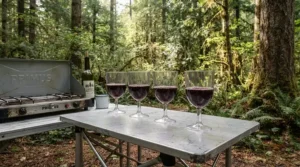
Picture the scene. The fire is crackling, the sky is doing that deep-blue trick it does around 9 p.m., and someone’s elbow meets a wine glass balanced on a stump. Crack. Now you’re picking shards out of the pine needles by headlamp. It’s a sound every camper dreads, and it’s entirely avoidable.

That’s the pitch for tritan plastic wine glasses for camping: the clarity and the sip of real glassware, minus the shatter. They’re lighter than glass and sturdier than the flimsy party cups that cloud over after two washes. Here’s the honest catch, though. Tritan is still plastic, and it won’t fool a sommelier holding it up to the light.
This guide covers seven real models, picked across budget, mid-range and premium. I haven’t held any of them, and this article doesn’t pretend otherwise. It’s built from spec sheets, manufacturer claims, aggregated reviewer sentiment and Canadian regulatory context. Where a model is mostly sold outside Canada, or the review pool is thin, I say so. Please check availability on amazon.ca before you order. We’ll also work through packing, care, campground alcohol rules and total cost over time, because a good glass is only half the story.
Quick Comparison: 7 Tritan Plastic Wine Glasses for Camping at a Glance
Prices below are approximate CAD ranges. They’re based on retail listings I found, converted and rounded, and they change often, so check current price before you buy.
| Product | Capacity | Style | Approx. Price Range (CAD) | Review Signal | Best For |
|---|---|---|---|---|---|
| Govino Red 16 oz | 473 ml | Stemless, thumb notch | Around C$20-C$35 (set) | Strong praise from boating and camping reviewers | Best overall camp glass |
| Govino White 12 oz | 355 ml | Stemless, thumb notch | Around C$20-C$35 (set) | Same line, same praise | Weight-conscious packers |
| Drinique 12 oz Stemless | 355 ml | Stemless, thick wall | Mid-C$ range per set of four | Reviewers like the heft | Rough-and-tumble family sites |
| Amazing Abby Sasha 14 oz | 414 ml | Stemless, set of six | Roughly C$30-C$55 (set of six) | Small, partly incentivized pool | Group campsites |
| Better Homes & Gardens 15 oz Tritan | 444 ml | Stemless | Under C$8 each | Large review count on retailer site | Tight budgets |
| Everclear Tritan 590 ml | 590 ml | Stemless, big bowl | Roughly C$30-C$50 (set of four) | Limited verifiable reviews | Generous red pours |
| Brunner Riserva | 450 ml | Stemmed | Roughly C$25-C$40 (pair) | Limited verifiable reviews | Campers who want a stem |
Look at the table and one trade-off jumps out. The Govino Red 16 oz and Govino White 12 oz share a design, so the choice between them is really about volume versus pack size. If you want a rugged feel and don’t mind a wider glass, the Drinique 12 oz Stemless is the one to examine. Value hunters should note that the Better Homes & Gardens 15 oz Tritan costs a fraction of the others, though it’s the one I’d trust least for brand-level durability claims.
💬 Just one click — help others make better buying decisions too!😊
What Is Tritan Plastic Wine Glasses for Camping? A Quick Definition
Tritan plastic wine glasses for camping are reusable, shatter-resistant drinking glasses moulded from Eastman’s Tritan copolyester. They’re sold without bisphenol A, they stay clear through repeated washing, and they weigh a fraction of glass. They suit campsites, boats, picnics and backpacking trips where real glassware is a liability.
That’s the 50-word version. The longer story starts in 2007, when Tritan copolyester arrived as a transparent plastic intended to replace polycarbonate over BPA health concerns. It’s made without bisphenols or phthalate plasticizers, which is why Nalgene-style water bottles switched to it.
For campers, three properties matter:
- Impact toughness. It bounces instead of shattering, which is the whole reason you’re reading this.
- Clarity. It stays glassy, where cheaper plastics haze.
- Dishwasher tolerance. Manufacturers say it survives hundreds of cycles without clouding. I’d treat that as a best-case claim, not a guarantee.
One wrinkle worth knowing: Zwiesel’s “Tritan” crystal glass is a completely unrelated product with a shared name. If a listing says “Tritan glass” rather than “Tritan copolyester” or “Tritan plastic”, you’re looking at something else.
Top 7 Tritan Plastic Wine Glasses for Camping: Expert Analysis
1. Govino Red 16 oz — best all-rounder for most campsites
Start with the reason Govino keeps winning boat and camp reviews: the thumb notch. It’s a small dent on the bowl that lets your thumb lock in, so a sweaty glass doesn’t slip out when you’re reaching for the chips.
The 16 oz red glass holds about 473 ml and is listed as Eastman Tritan with a polished, rounded rim. That means a thin, wine-like lip rather than a thick plastic edge. The current line is also listed in Tritan Renew, with 50% certified recycled content. A 473 ml bowl gives a proper swirl for a medium red and still allows a generous 150 ml pour.
Based on the spec sheet, this is the glass to buy if you can only buy one design. One boating reviewer who tried the redesigned, rigid Tritan version called it a favourite and said a friend mistook it for glass until picking it up. They also noted it’s still plastic and won’t feel like fine crystal. Older reviews describe the original soft, flexible Govino. That’s a different material, so weigh them accordingly.
Pros:
- ✅ Thumb notch gives a secure grip
- ✅ Thin polished rim feels wine-like
- ✅ Recycled-content Tritan option
Cons:
- ❌ Doesn’t nest well when packed
- ❌ Top-rack dishwasher only
Expect a small set at around C$20-C$35. It’s a solid value verdict for a glass built for this exact job.

2. Govino White 12 oz — smallest footprint in the Govino line
If every gram and every centimetre counts, the Govino White 12 oz is the same idea in a smaller bowl. It holds roughly 355 ml and stands about 9-10 cm tall according to listed dimensions. For white, rosé or a light pinot, that’s a perfectly sized glass.
The practical edge is the carrying footprint. A set of four fits more easily into a camp kitchen bin than the larger red glass. For a backpacking dining kit where mugs, spork and stove already fight for space, that matters. A listing for the wider line describes the glass as shatterproof, reusable and top-rack dishwasher safe.
Here’s what the spec sheet won’t tell you, but older reviewers hint at: these glasses don’t nest. Plan on carrying them in a mug or pot for protection, which brings us to the packing section later.
A reviewer of the earlier flexible Govino reported roughly 0.85 oz per glass, and the rigid redesign is likely similar in the hand. I’d treat that number as an older-generation data point, not a spec for the current model.
Pros:
- ✅ Compact enough for lean kits
- ✅ Right size for white and rosé
- ✅ Same grip notch as the red
Cons:
- ❌ Too small for a big red pour
- ❌ Doesn’t stack inside itself
Prices land in the same C$20-C$35 band for a small set. Check current price, because that’s the whole value story.
3. Drinique 12 oz Stemless — rugged feel for chaotic family sites
The Drinique 12 oz Stemless is the heavyweight of this list. Drinique’s pitch is clarity that survives repeated commercial dishwashing; the maker claims clarity holds even after 1,000 cycles. As with any manufacturer claim, I’d read that as “built for restaurants”, which is a useful sign for campers.
Reviewers on a retailer listing describe the glasses as heavy-duty and break resistant, not flimsy. One buyer reported two earlier sets of PET plastic wine glasses that went cloudy within months. That’s a helpful contrast: Tritan and PET age differently in the dishwasher. Another reviewer warned the wide base won’t fit standard cup holders, which is worth knowing if you’re car camping and juggling a console.
Based on the specs, this is my pick for families who treat glassware like a rugged utility item. The trade-off is weight and bulk. A four-pack takes real room, so it’s better suited to car camping than to a canoe route.
Pros:
- ✅ Thick, sturdy feel in the hand
- ✅ Reported to resist clouding long term
- ✅ Made in the USA, BPA-free
Cons:
- ❌ Wide base misses many cup holders
- ❌ Bulkier than thinner-walled rivals
Expect a mid-range price for a set of four. It’s good value if you keep them for a decade.
4. Amazing Abby Sasha 14 oz — best set size for big campsites
Six glasses in a box is the story. The Amazing Abby Sasha 14 oz comes as a set of six, holds roughly 414 ml, and is listed as BPA-free and lead-free Tritan plastic. For a group site where you’d otherwise buy two sets and end up with mismatched extras, six is the right quantity.
Here’s my honest caution on reviews. The retailer listing I found carried five-star feedback that was labelled “incentivized”. One buyer liked a poolside glass that looks and feels like a true wine glass, and mentioned buying a second set. Incentivized reviews tell you the glass isn’t broken, but not much more. So treat durability as plausible but not proven, and read recent buyer feedback on amazon.ca.
The bowl is a generous 14 oz, which suits a reasonable red or white pour. On paper, it’s the most sensible option when you’re feeding and watering a crowd.
Pros:
- ✅ Six glasses covers most groups
- ✅ Mid-sized bowl for red or white
- ✅ BPA-free, dishwasher safe
Cons:
- ❌ Review pool partly incentivized
- ❌ Box of six eats pack space
Estimate roughly C$30-C$55 for the set, which works out cheaply per glass.
5. Better Homes & Gardens 15 oz Tritan — the cheapest glass to lose
Sometimes the best camping gear is the stuff you won’t cry over. The Better Homes & Gardens 15 oz Tritan sat at around US$2 per glass on one retailer listing, with over a hundred reviews on that site. At that price, a lost glass is a rounding error.
It holds about 444 ml in a stemless shape and is labelled Tritan plastic. I couldn’t verify a manufacturer’s durability claim as strong as the Govino or Drinique ones, so I’d place this firmly in the “good enough, cheap, replaceable” camp. It suits kids’ tables, beach days and the second set you keep in the trailer.
On paper, this is the pick for anyone starting out. Buy two, see how you feel about the weight and rim, then upgrade if you fall for the hobby. Be aware that availability in Canada isn’t guaranteed. This is a Walmart-brand line, so check what’s on amazon.ca before you commit.
Pros:
- ✅ Extremely low cost per glass
- ✅ Generous 15 oz bowl
- ✅ Easy to replace mid-season
Cons:
- ❌ Fewer verified durability details
- ❌ Canadian availability varies
Budget under C$8 per glass, which is a clear value win for casual use.

6. Everclear Tritan 590 ml — the big-bowl red-wine option
If you swirl big reds, here’s your glass. The Everclear Tritan 590 ml is sized to give a full-bodied wine room to breathe. A retailer listing describes it as impact-resistant, BPA-free, dishwasher safe, and freezer safe, which is a nice trick for chilling a rosé before a sunset toast.
The listing also says the Tritan carries GREENGUARD indoor-air certification. That’s a manufacturer claim, but a reassuring one. The brand is better known in Australia and New Zealand, so Canadian stock may be patchy. I’d confirm it on amazon.ca before getting attached.
My analysis: the volume is both the strength and the weakness. A 590 ml bowl is happy with a 150 ml pour of red, but it’s a lot of plastic to pack. Think car camping, glamping and cabin weekends rather than ultralight trips.
Pros:
- ✅ Big bowl suits full reds
- ✅ Freezer safe for chilling
- ✅ Impact-resistant Tritan build
Cons:
- ❌ Bulky for small packs
- ❌ Limited Canadian review data
Plan on roughly C$30-C$50 for four, so it’s decent value if the size suits your drinking.
7. Brunner Riserva — the only real stemware here
Some people just want a stem. The Brunner Riserva is a pair of stemmed Tritan glasses at 450 ml, about 20 cm tall and 6.5 cm across the base, listed as dishwasher safe up to 80 °C. A UK retailer describes it as virtually unbreakable while keeping the feel of glass.
The stem gives you that classic hold, keeps warm hands off the bowl, and adds a touch of occasion to a romantic site for two. The downside is obvious. A tall stem is the first thing to snap under real abuse, and it needs a case or a tall mug for transport. I’d treat this as a car camping luxury for couples, not a family workhorse.
This brand is mostly sold in Europe, so Canadian availability may require importing. Check before ordering.
Pros:
- ✅ Genuine stemmed wine-glass feel
- ✅ Dishwasher safe to 80 °C
- ✅ Pair is easy to gift
Cons:
- ❌ Awkward to pack and protect
- ❌ Possibly hard to source in Canada
Estimate roughly C$25-C$40 for the pair. The value verdict is fair for a niche item.
How to Choose Tritan Plastic Wine Glasses for Camping
Picking a glass shouldn’t need a spreadsheet, but a few criteria separate a keeper from a regret:
- Confirm the material. Look for “Tritan copolyester” in the listing. If it says acrylic, SAN or PET, it’s a different plastic with different durability.
- Match capacity to your wine. About 355 ml suits whites; 415-590 ml suits reds that need swirl room.
- Decide stem or stemless. Stemless is sturdier and packs smaller. A stem is prettier and breaks first.
- Check the care label. Top-rack-only or hand-wash-only changes your cleanup routine.
- Think about nesting. Glasses that stack or nest save serious pack space.
- Count your crowd. Sets of four suit couples; sets of six or eight suit families.
- Verify Canadian availability. A great glass that ships from overseas can cost more in time than in dollars.
Reviewers consistently reward the glasses that behave like glass in the hand, and punish the ones that feel like party cups.
✨ Ready to Upgrade Your Campsite Pour?
🔍 Take your camp kitchen to the next level with these carefully selected glasses. Click any highlighted product name to check current pricing and availability. A good set will make your next fireside toast feel a little more civilized!
Features That Actually Matter (And Those That Don’t)
Marketing copy loves a long list. Let’s separate signal from noise for lightweight tritan stemware and stemless picks alike.
Features worth paying attention to:
- Rim thickness. A thin, polished lip is what makes plastic feel like wine glass. A fat moulded rim ruins the sip.
- Grip design. Thumb notches and contoured bases matter more than you’d guess when your hands are wet and cold.
- Rated dishwasher method. “Dishwasher safe” can mean top rack only, so read the fine print.
- Weight per glass. Lightweight tritan stemware sounds appealing, but stemless glasses are generally lighter and tougher than stemmed ones.
Features you can ignore:
- “Crystal clear” claims. Almost every listing says it.
- Colour tints. Pretty, but they hide wine colour.
- Giant sets. Twelve glasses only help if you host twelve.
The spec sheet won’t tell you this, but user reports suggest the dishwasher is where cheap plastic dies. Cloudy glasses are the classic complaint with PET. Tritan’s selling point is resisting that haze, and manufacturers say it holds clarity through hundreds of cycles.
One more honest caveat. A materials database notes Tritan has limited UV resistance, so don’t leave your glasses baking on a dashboard all summer. Store them in a bag or bin, and they’ll look better for longer.
Tritan vs Glass vs Other Plastics: A Camping Comparison
How does Tritan stack up against the alternatives you’d actually consider? Here’s a plain-language comparison for campsite use.
| Material | Break Risk | Weight | Clarity Over Time | Best For |
|---|---|---|---|---|
| Real glass | High | Heavy | Excellent | Cabin and glamping dinners |
| Tritan copolyester (Govino Red 16 oz, Drinique 12 oz Stemless) | Very low | Light | Good, resists haze | Most camping |
| PET or acrylic party cups | Low-moderate | Very light | Often clouds | Disposable-adjacent use |
| Silicone or stainless | Very low | Light | Not clear | Backpacking, hot drinks |
The comparison makes the logic clear. Real glass wins on taste and loses on everything else a campsite throws at it. Disposable-style plastics are cheap but tend to haze, as one reviewer noted of two earlier PET sets. Tritan lands in the middle, which is exactly where campers live.
If you’re weighing a stainless tumbler against Everclear Tritan 590 ml, ask yourself what matters more: seeing the wine’s colour or keeping it chilled. Stainless wins on insulation. Tritan wins on the ritual.
BPA-Free Plastics: What the Label Really Means in Canada
Let’s talk about BPA-free plastics, because the label gets thrown around loosely. BPA is an industrial chemical used to make polycarbonate. Health Canada’s BPA page says most Canadians have low exposure that doesn’t pose a health risk. It also notes newborns and infants are protected under the Canada Consumer Product Safety Act.
Canada was also the first jurisdiction to declare BPA toxic under its environmental law and to restrict BPA in baby bottles. CBC’s reporting reminds us that regulators say dietary exposure is not expected to pose a health risk, while some scientists warn about very low doses. The debate isn’t fully settled.
So why choose BPA-free glassware? Because it’s a sensible precaution at no real cost. Tritan is made without bisphenols, and Eastman’s own testing reports no BPA and no estrogenic activity. That’s a manufacturer claim backed by third-party labs. It isn’t a blanket guarantee for every product that borrows the Tritan name.
Practical tips for safe use:
- Prefer glasses labelled Tritan copolyester over vague “BPA-free plastic”.
- Avoid glasses that are scratched deeply, stained or smell odd.
- Follow the maker’s heat guidance, and don’t assume every glass tolerates boiling liquids.
- Skip the microwave unless the maker says it’s fine. One retailer’s care sheet says no, while Eastman describes food-container grades as microwavable.
Packable Wine Glasses for Camping: A Step-by-Step Packing Guide
Packable wine glasses for camping only pay off if they survive the trip. Here’s a simple system that protects them without wasting space.
- Choose your container. A lidded camp pot, a tall mug or a small hard-sided bin works best.
- Nest where you can. Many Tritan stemless glasses don’t nest cleanly, so wrap each in a bandana or microfibre cloth before stacking.
- Bag the set. Some sets, like Sip Bubbles’ four-pack, ship with a cotton drawstring tote. You can copy that with any small stuff sack.
- Place them mid-pack. Keep glasses away from sharp tent stakes, fuel canisters and cast iron.
- Dry before storing. Damp plastic packed in a closed bin invites odours.
Think of this as a short layer in your camping gear essentials list. Here’s a rough priority order:
- Shelter, sleep system, stove and fuel
- Water treatment and a good lighting setup
- Cookware, utensils and a camp sink or basin
- Then the small luxuries: coffee setup, camp chairs and a pair of Govino White 12 oz or Govino Red 16 oz
For a backpacking dining kit, I’d go lean. One glass per person, stemless, packed inside a mug. Skip the stemmed Brunner Riserva for trail trips, and save it for the car-camping weekend.

Building a Backpacking Dining Kit Around One Good Glass
A backpacking dining kit lives or dies by weight and redundancy. Every item should do two jobs, and a Tritan glass can double as a measuring cup, a cereal bowl in a pinch, or a cold-drink vessel.
Here’s a sample kit built around one glass per person:
- Sipping vessel: a stemless Tritan glass, such as the Govino White 12 oz for its smaller size.
- Eating: a long-handled spork and a lightweight bowl.
- Cooking: a small pot that doubles as the glass’s travel case.
- Cleaning: a quarter sponge and a small bottle of biodegradable soap.
The pot trick is the star. Slip a wrapped glass into your cooking pot, and the pot’s walls take the pressure that would otherwise squeeze it in your pack.
Ask yourself two questions before you commit to carrying a wine glass on foot. Is the weight worth the ritual? And could a stainless cup do the job? If the answer to the first is “absolutely”, then a small stemless Tritan glass is a modest indulgence. A glass of around 24 g, such as the older flexible Govino reviewers described, barely registers next to a stove.
For group trips, share the load. One person carries the glasses, another carries the bottle in a protective sleeve, and a third brings the cheese.
Real-World Scenarios: Matching the Right Glass to the Right Camper
Specs only help if they match real life. Here are three camper profiles, with the best-fit glass for each.
The weekend car-camping couple. Two people, a Subaru, a cooler and a bottle of red. Budget is flexible, space is generous. The Everclear Tritan 590 ml gives a full-bodied pour, while the Brunner Riserva adds a little romance. Frequency of use is perhaps eight weekends a year, so either glass will see modest wear.
The family of five at a provincial park. Kids, dogs, folding tables and constant motion. Here, durability and quantity win. A set of Amazing Abby Sasha 14 oz covers six, and the Drinique 12 oz Stemless adds sturdiness for adult glasses. Because family sites are chaotic, replacement cost matters, which is where the Better Homes & Gardens 15 oz Tritan earns its spot as a spare set.
The weekend backpacker. Two nights, 15 km in, every gram debated. One Govino White 12 oz each, wrapped in a bandana and tucked in a cooking pot, is a sensible luxury. The environment is rough, so the thumb notch helps with cold, wet hands.
Notice a pattern? The best glass isn’t the fanciest one. It’s the one that matches how and where you camp, and how much you’d mind losing it.
Long-Term Cost and Maintenance: Is Tritan Worth It?
Total cost of ownership is where Tritan quietly wins. A single glass wine glass in a campsite might last one season. A good Tritan glass, treated reasonably, can last many.
| Option | Upfront Cost (approx. CAD) | Replacement Risk | Long-Term Value |
|---|---|---|---|
| Better Homes & Gardens 15 oz Tritan | Under C$8 each | Moderate; low cost to replace | Great starter value |
| Govino Red 16 oz | Around C$20-C$35 per small set | Low | Strong; designed for this job |
| Drinique 12 oz Stemless | Mid-range set of four | Very low | Excellent if clarity claims hold |
| Glass stemware | Varies | High | Poor for camping |
Looking at the table, the cheapest glass is rarely the cheapest over a decade. A Drinique 12 oz Stemless set that lasts ten years costs pennies per use, while a glass that clouds in a season is a recurring expense. The Better Homes & Gardens 15 oz Tritan flips that logic, though, because it’s so cheap that replacement hardly hurts.
Maintenance is simple. Don’t let dirty drinkware sit overnight, rinse dried wine promptly, skip abrasive scrubbers, and use the top rack. Those tips come from care guides for commercial Tritan drinkware, and they cost you nothing.
Campground Alcohol Rules in Canada: Check Before You Pour
You’ve bought the glasses. Now make sure you’re allowed to fill them. Rules differ across the country, and they change.
Parks Canada has used summer long-weekend alcohol and cannabis bans in some mountain parks. For 2026, a Yoho National Park bulletin covers the Victoria Day, Heritage Day/BC Day and Labour Day long weekends at named campgrounds. It lists penalties that can include permit cancellation, eviction or charges, with a maximum penalty of $25,000. Banff has run similar bans, and reporting says the same pattern has repeated for several years. Those 2026 dates have passed, but expect similar notices for 2027.
Other places are more relaxed. A Kejimkujik National Park bulletin permits drinking on a campsite with a valid camping permit, but not in public areas. Ontario has also reported expanded alcohol rules in provincial parks for adults 19 and older, though signage still restricts some areas.
Your checklist:
- Read the park or campground bulletin before you leave.
- Keep open containers at your registered campsite.
- Use tough, quiet glassware. Tritan beats glass for safety if a glass drops near bare feet.
Rules can change quickly, so always confirm directly with the park.

FAQ
❓ Are tritan plastic wine glasses for camping worth it over acrylic?
❓ How many tritan plastic wine glasses should I pack for a family site?
❓ Can I use Tritan glasses for hot drinks like mulled wine?
❓ Do Tritan wine glasses go cloudy in the dishwasher?
❓ Where can I buy tritan plastic wine glasses for camping in Canada?
Conclusion
Let’s land this plane. If you want one glass that does the job well in most situations, the Govino Red 16 oz is the safest recommendation, with the Govino White 12 oz as its leaner sibling. If your campsite is loud, sticky and full of kids, the Drinique 12 oz Stemless or the group-friendly Amazing Abby Sasha 14 oz makes more sense. Budget hunters can start with the Better Homes & Gardens 15 oz Tritan and upgrade later. Big-red drinkers should look at the Everclear Tritan 590 ml, and romantics willing to babysit a stem can consider the Brunner Riserva.
Remember the honest limits, too. Tritan is excellent plastic, but it’s still plastic. Some of these glasses are mostly sold outside Canada, and some review pools are thin or partly incentivized. Check current price and availability on amazon.ca, read recent buyer feedback, and follow the care label.
Pair your glasses with a smart packing system, a small backpacking dining kit if you hike, and a quick check of campground alcohol rules. Do that, and the next time an elbow meets a glass at your campsite, the only sound will be a gentle bounce and a collective sigh of relief.
Recommended for You
- Acrylic Wine Glasses Set: 7 Best Shatterproof Picks For 2026
- Stainless Steel Wine Tumblers: 7 Best Unbreakable Picks 2026
- Machine-Made Wine Glasses Vs Handblown: 7 Ultimate Picks 2026
Disclaimer: This article contains affiliate links. As an Amazon Associate, I earn from qualifying purchases. If you purchase products through these links, we may earn a small commission at no additional cost to you.
✨ Found this helpful? Share it with your friends! 💬🤗
